
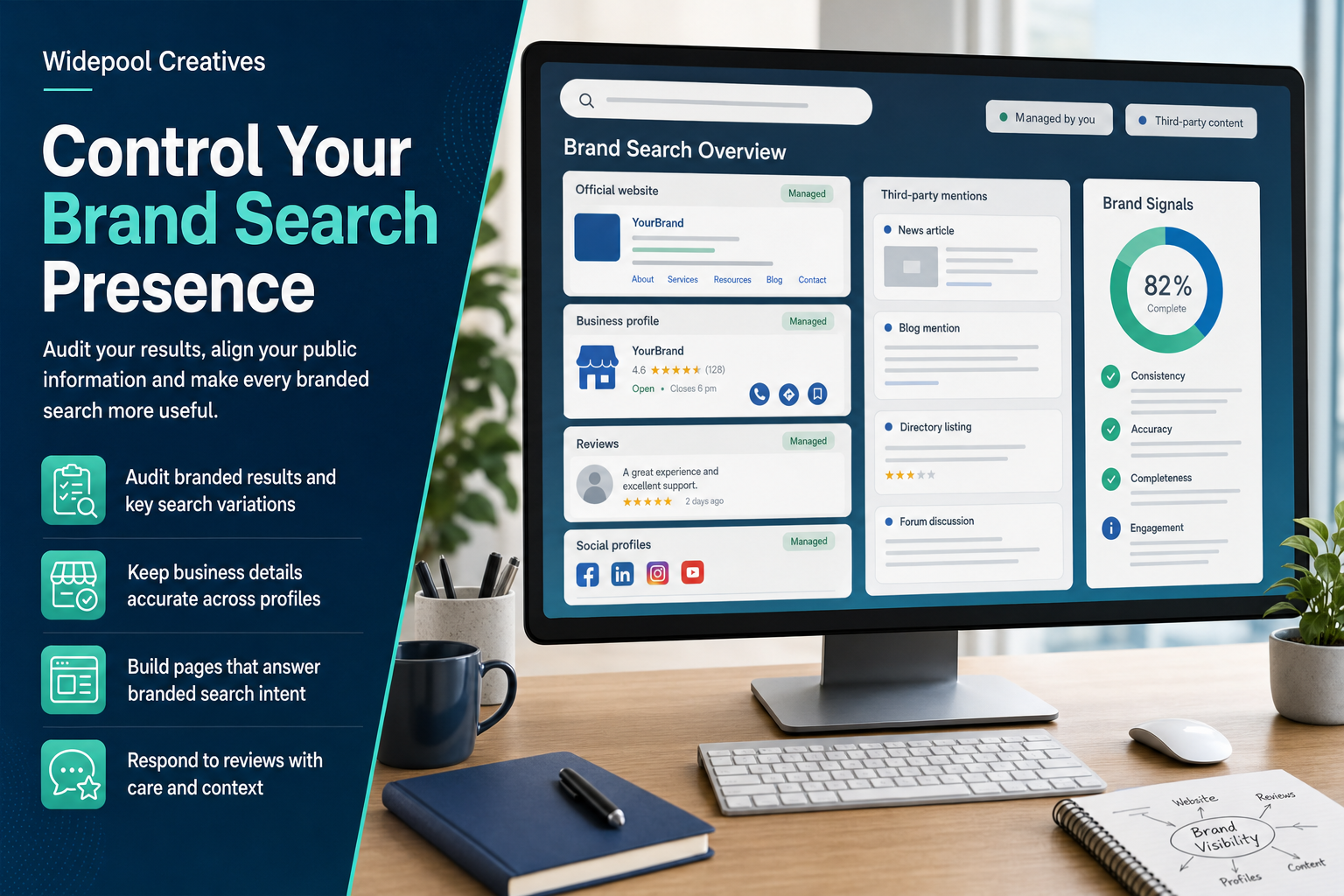
Brand SERP optimization is the practice of improving what people see when they search for your business name, from your website and company profiles to reviews and other public information. A 2025 Pew Research Center study found that users clicked a traditional search result in 8% of visits when a Google AI summary appeared, compared with 15% when it did not. The study covered searches generally, not branded searches specifically, but it illustrates why information visible on the results page matters.
Someone searching for your brand may be checking your services, looking for contact details or comparing businesses. An outdated listing or a confusing mix of similarly named companies can make those tasks harder. You cannot control every result, but you can improve the information you manage and correct inaccuracies where possible.
Understanding a brand search results page
A brand search results page is the collection of results shown when someone searches for a business, product or person by name. It can include the official website, service pages, social profiles, reviews, news stories, images and a knowledge panel. The mix varies by searcher, location, device and Google’s assessment of relevance.
Branded search results also appear for more specific searches, such as your company name followed by “reviews,” “services,” “contact” or a product name. These searches offer clues about what people want to know. Your website can answer some of those needs, while independent reviews and publications provide perspectives beyond your own pages.
Audit your Google brand SERP
Search for your business name and record what appears on the first page. Repeat the exercise for common variations, including your name with “reviews,” “contact,” your main service and relevant locations. Check whether each result is accurate and useful, not just where it ranks.
Results can vary, so one search is only a snapshot. Where practical, compare desktop and mobile results and check the locations that matter to your business. Keep a dated record to make later comparisons easier.
- Identify your official assets. Note your website, social accounts, business listings and other profiles that you own or manage.
- Review third-party mentions. Look at directories, review platforms, publications and partner pages that appear for your name.
- Check for inconsistencies. Compare names, website addresses, contact details, descriptions and service information.
- Examine customer intent. Note the questions implied by related searches and the pages that currently answer them.
- Prioritize improvements. Address inaccurate contact information and serious customer concerns before cosmetic changes.
For example, if a directory shows an old phone number, update the listing if you manage it or ask its publisher for a correction. Then check that the contact details on your website are current.
Build a useful website for branded searches
Your website is the source you can manage most directly. Clear page titles, descriptive content, internal links and accessible contact information help visitors navigate your business and help search engines understand each page.
Start with pages that answer common questions:
- Homepage: Explain who you are, what you offer and whom you serve.
- Service pages: Describe individual services, their applications and how to enquire.
- About page: Provide a factual account of your business, its approach and relevant experience.
- Contact page: Make enquiry options easy to find and keep details current.
- Supporting content: Publish useful explanations, examples or case studies that you can substantiate and have permission to share.
Pages should also be mobile-friendly, load efficiently, use meaningful headings and be accessible to search engines where appropriate. Use Google Search Console’s page indexing report to investigate indexing issues, fix broken links and write descriptive title tags rather than repeating a generic title across the site.
Google may generate sitelinks or rewrite a displayed title; neither can be dictated precisely. A logical site structure and helpful titles give search engines information to work with and make the website easier for people to use.
Influencing a brand knowledge panel
A brand knowledge panel is an information box that Google may display for an organization it recognizes. Businesses can clarify their public information, but they cannot guarantee that a panel will appear or dictate every detail. Google determines whether and how to show one.
Maintain a clear About page, link to genuine social accounts and keep your business details current. Structured data can describe your organization in a machine-readable format, but it should reflect accurate information supported by the site. See Google’s organization structured data guidance for the supported properties and implementation requirements.
If a panel exists, an authorized representative may be able to claim it and suggest changes. Google explains the process for claiming a knowledge panel. Independent sources can also contribute context. Avoid purchasing dubious listings or publishing misleading claims in an attempt to force recognition.
Reviews and online reputation SEO
Online reputation SEO includes attention to the public information people find about your business, such as reviews, listings and independent mentions. Address real concerns, correct inaccurate details where possible and make it easy for customers to share honest experiences.
When responding to a negative review, acknowledge the issue, avoid sharing private customer details and offer an appropriate route to resolve it. If a review violates a platform’s policies, use its reporting process; an unfavorable opinion alone is not necessarily grounds for removal.
Thank customers for positive feedback without treating every response as a sales pitch. Follow the relevant platform’s policies when asking for reviews, and do not buy reviews or selectively misrepresent customer experiences.
Where your control begins and ends
You have the most direct control over your website and the profiles you manage. You can influence other elements by providing accurate information and responding to feedback, but search engines and third-party publishers make their own decisions.
| Search element | Level of control | Practical action |
|---|---|---|
| Official website pages | Direct | Improve content, titles, navigation, technical performance and contact options. |
| Managed social and business profiles | Substantial, subject to platform rules | Update descriptions, links and business details; maintain active profiles where useful. |
| Customer reviews | Limited | Provide good service, invite honest feedback and respond constructively. |
| News and independent mentions | Limited | Share accurate information and request corrections when factual details are wrong. |
| Knowledge panels and search features | Indirect | Maintain accurate information and use applicable verification or feedback processes. |
Connect search results to useful next steps
A relevant result is only part of the experience. Once someone reaches your website, they should be able to understand the offer and find a way to enquire without hunting for essential information.
For example, a search for your brand plus a service may be better served by a page explaining that service than by a generic homepage alone. The page can describe whom the service is for, what the process involves and how to enquire. Clear forms, working telephone links and mobile-friendly layouts can reduce unnecessary barriers.
Measure progress in context
Combine search visibility, information accuracy and business outcomes. Track branded queries and landing pages in Google Search Console, review organic engagement in your analytics platform and monitor enquiries from relevant pages. Google’s performance report guidance explains the available search metrics and filters.
- Search visibility: Monitor branded impressions, clicks and the pages appearing for important brand queries.
- Information quality: Record corrections to outdated listings, broken links and inconsistent contact details.
- Engagement: Examine whether visitors reach useful service and contact pages.
- Enquiries: Track form submissions, calls and other meaningful actions where measurement is available and appropriate.
- Reputation: Review recurring feedback themes and whether customer concerns are being addressed.
Compare results over time rather than relying on a single ranking or one day’s search results. Branded search volume can change because of advertising, seasonality, referrals or market activity—not SEO alone. Search features can also change without any action by your business.
Common mistakes to avoid
Avoid treating the homepage as the entire strategy, neglecting third-party profiles or assuming that search results will remain accurate without maintenance. Thin service pages and unresolved customer concerns can make it harder for people to understand your business.
Also consider the experience after the click. A strong search result may not lead to an enquiry if a visitor cannot find the relevant service or contact option. Adding structured data without supporting it with visible, accurate information is not a substitute for a useful site.
About Widepool
Widepool is a digital marketing service provider offering SEO services to businesses in India and welcoming enquiries from organizations worldwide. Work can include reviewing current search visibility and identifying practical improvements to website content, structure and relevant online profiles.
For example, an initial review could identify an outdated directory listing or a service search that leads to a generic page. The appropriate response would depend on the business’s circumstances and the agreed scope of work. Results also depend on factors such as competition, website condition and search engine changes.
Discuss your search presence
If you would like to discuss your requirements with Widepool, submit the contact form or call +91 9019676890 or +91 9986450820 to request a meeting. You can also send a WhatsApp message using the interface on the Widepool website.