
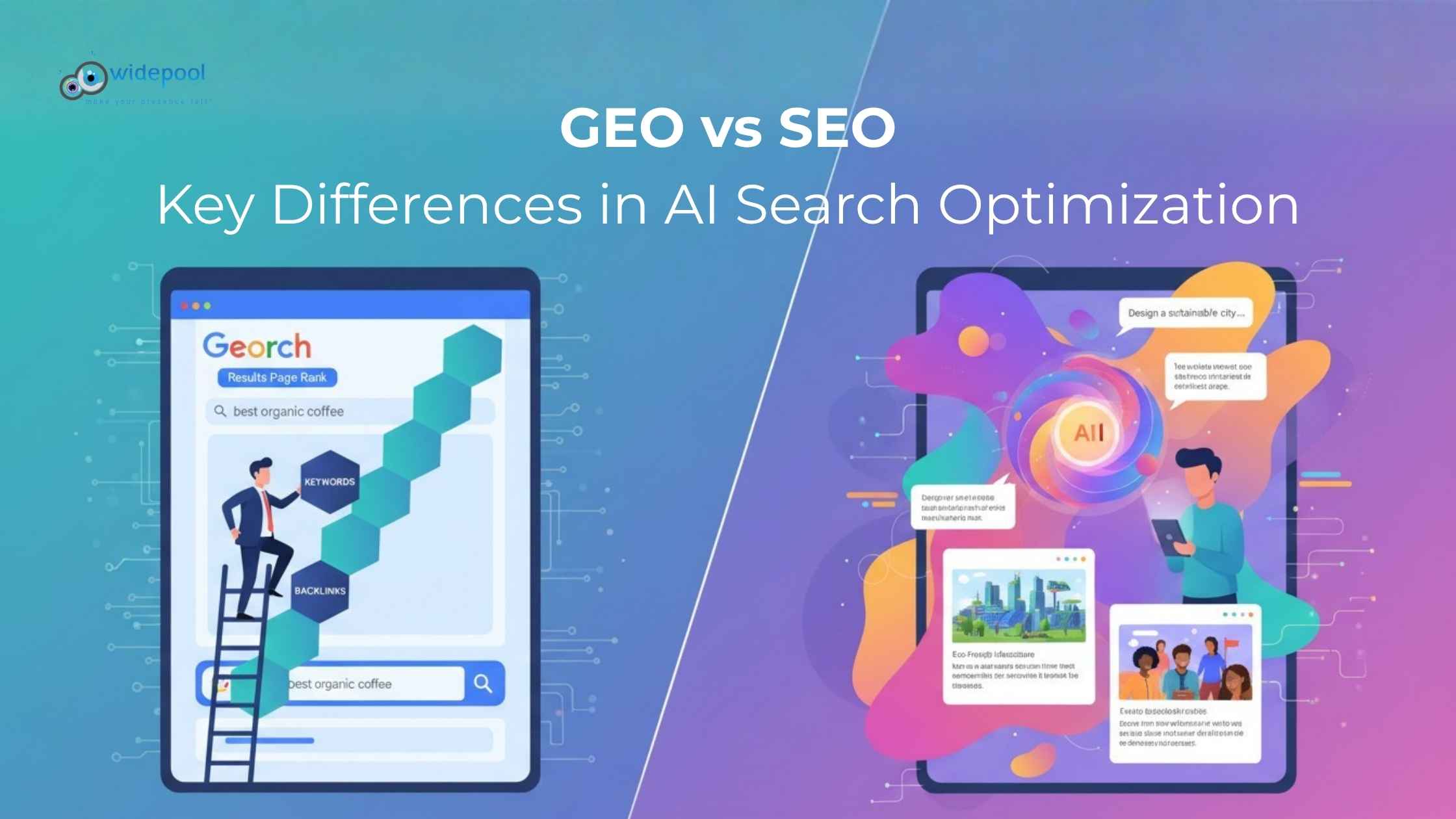
GEO vs SEO: Key Differences in AI Search Optimization
Did you know? Over 60% of searches in 2026 are influenced by AI-generated responses rather than traditional search result listings. This shift has redefined how businesses approach visibility online, making the debate around GEO vs SEO more critical than ever before.
If your business is still relying solely on traditional search strategies, you may already be losing valuable traffic, leads, and revenue. The rise of AI-driven search engines has introduced a new paradigm—Generative Engine Optimization (GEO)—which is fundamentally changing how users discover content.
In this comprehensive guide, we explore the difference between GEO and SEO, how AI is reshaping search, and why partnering with Widepool can position your brand ahead of competitors in this evolving digital landscape.
What is GEO vs SEO and why does it matter?
GEO vs SEO refers to the comparison between Generative Engine Optimization (GEO) and Search Engine Optimization (SEO). While SEO focuses on ranking web pages in search engine results, GEO focuses on optimizing content to be featured within AI-generated responses.
This distinction matters because user behavior is changing rapidly:
- Users increasingly rely on AI summaries instead of clicking multiple links
- Voice search and conversational queries are rising
- Search engines now prioritize context and intent over keywords
Ignoring this shift means your business risks becoming invisible in AI-powered search environments.
What is the difference between GEO and SEO?
The difference between GEO and SEO lies in how content is optimized and consumed. SEO targets search engines, while GEO targets AI systems that generate answers.
| Aspect | SEO | GEO |
|---|---|---|
| Primary Goal | Rank on SERPs | Appear in AI-generated responses |
| Content Focus | Keywords | Context and intent |
| User Interaction | Clicks | Direct answers |
| Technology | Search algorithms | AI models and LLMs |
This GEO comparison highlights why businesses must evolve their strategies to remain competitive.
How does AI SEO vs traditional SEO differ?
AI SEO vs traditional SEO is one of the most discussed topics in digital marketing today. Traditional SEO relies on keyword density, backlinks, and technical optimization. AI SEO, however, focuses on understanding user intent, semantic relevance, and conversational context.
Key differences include:
- Traditional SEO: Optimizes for search engine crawlers
- AI SEO: Optimizes for AI understanding and response generation
- Traditional SEO: Focuses on rankings
- AI SEO: Focuses on visibility within AI answers
This shift is not optional—it is essential for survival in the digital marketplace.
What are AI search ranking factors?
AI search ranking factors differ significantly from traditional ranking signals. AI models evaluate content based on meaning, authority, and usefulness rather than just keywords.
Important factors include:
- Semantic relevance and topic depth
- Content clarity and structure
- Authority and trustworthiness (EEAT)
- Conversational tone and natural language
- Structured data and schema markup
Widepool integrates these advanced factors into every strategy, ensuring your content is optimized not just for today’s search engines but for tomorrow’s AI-driven ecosystem.
Semantic SEO vs GEO: what’s the connection?
The relationship between semantic SEO vs GEO is crucial. Semantic SEO focuses on context and meaning, which forms the foundation of GEO strategies.
While semantic SEO improves how search engines understand your content, GEO ensures that AI systems can extract and present your content as authoritative answers.
In simple terms:
- Semantic SEO prepares your content
- GEO amplifies its visibility in AI responses
Widepool combines both approaches to create a powerful, future-ready optimization strategy.
What is the future of SEO 2026?
The future of SEO 2026 is deeply intertwined with AI. Search engines are no longer just indexing pages—they are interpreting, summarizing, and generating answers.
Emerging trends include:
- AI-generated search results replacing traditional listings
- Increased importance of structured data
- Voice and conversational search dominance
- Zero-click searches becoming the norm
Businesses that fail to adapt will struggle to maintain visibility. Those who embrace GEO alongside SEO will dominate their industries.
Why businesses are losing leads without GEO
Problem: Many businesses invest heavily in SEO but still see declining traffic.
Agitation: This happens because users are no longer clicking through search results—they are getting answers directly from AI.
Solution: GEO ensures your brand becomes part of those answers.
Without GEO:
- Your competitors appear in AI responses
- Your content remains unseen
- Your lead generation declines
With Widepool’s expertise, your business stays visible where it matters most.
How Widepool transforms your digital presence
Widepool is a digital marketing agency specializing in SEO and AI-driven optimization strategies. Their approach combines traditional SEO excellence with cutting-edge GEO methodologies.
What makes Widepool different?
- Deep understanding of AI search ecosystems
- Customized strategies for each business
- Focus on measurable ROI and lead generation
- Expert implementation of schema and structured data
They don’t just optimize websites—they transform them into powerful lead-generation engines.
How to get started with Widepool
If you want to stay ahead in the evolving landscape of GEO vs SEO, now is the time to act.
You can connect with Widepool through multiple channels:
- Fill out the contact form: https://widepool.com/contact/
- Call: +91 9019676890 or +91 9986450820
- Send a WhatsApp message via their website
Their team will get in touch to understand your business needs and craft a strategy that drives real results.
About Widepool
Widepool is a leading digital marketing service provider based in India, specializing in SEO, AI search optimization, and performance-driven marketing strategies. With a strong focus on innovation and measurable growth, Widepool helps businesses achieve higher visibility, better engagement, and increased revenue.
Learn more at: https://widepool.com/
Frequently Asked Questions
What is GEO vs SEO and why does it matter in AI search?
GEO vs SEO refers to the shift from traditional keyword-based optimization to strategies that focus on how AI systems generate and deliver answers. While SEO aims to rank pages in search results, GEO ensures your content is selected, synthesized, and presented by AI-driven platforms. This matters because modern users increasingly rely on AI-generated summaries rather than clicking multiple links.
What is the difference between GEO and SEO in practical terms?
The difference between GEO and SEO lies in intent and execution. SEO focuses on rankings, backlinks, and keywords, whereas GEO prioritizes structured, context-rich, and AI-readable content. GEO ensures your brand appears in AI-generated answers, while SEO ensures visibility in traditional search engine results pages.
How does AI SEO vs traditional SEO impact content strategy?
AI SEO vs traditional SEO changes how content is created. Traditional SEO relies heavily on keyword placement, while AI SEO emphasizes intent, clarity, and semantic depth. Content must answer questions directly, use structured data, and align with conversational queries to be favored by AI systems.
What role does semantic SEO vs GEO play in modern optimization?
Semantic SEO vs GEO highlights the evolution from understanding keywords to understanding meaning. Semantic SEO improves context within search engines, while GEO goes further by optimizing content for AI interpretation and generation. GEO ensures your content is not just indexed but also used in AI responses.
What are the key AI search ranking factors businesses should focus on?
AI search ranking factors include content clarity, contextual relevance, structured formatting, authority signals, and real-time adaptability. Unlike traditional ranking signals, AI evaluates how well content answers user intent and whether it can be confidently included in generated outputs.
How does Widepool help with GEO comparison and implementation?
Widepool provides a comprehensive GEO comparison framework that helps businesses understand where they stand between traditional SEO and AI-driven optimization. Their solutions include AI-ready content structuring, entity-based optimization, and continuous performance tracking tailored for generative search environments.
What is the future of SEO 2026 and beyond?
The future of SEO 2026 is deeply tied to AI-powered search experiences. Traditional rankings will coexist with AI-generated answers, making GEO essential. Businesses must optimize for both discoverability and answer inclusion to stay competitive in this evolving landscape.
Why should businesses invest in GEO alongside SEO today?
Investing in GEO alongside SEO ensures long-term visibility. As AI platforms increasingly dominate search behavior, relying solely on traditional SEO can limit reach. GEO enables brands to be part of AI-generated answers, enhancing authority, trust, and user engagement across modern search ecosystems.