
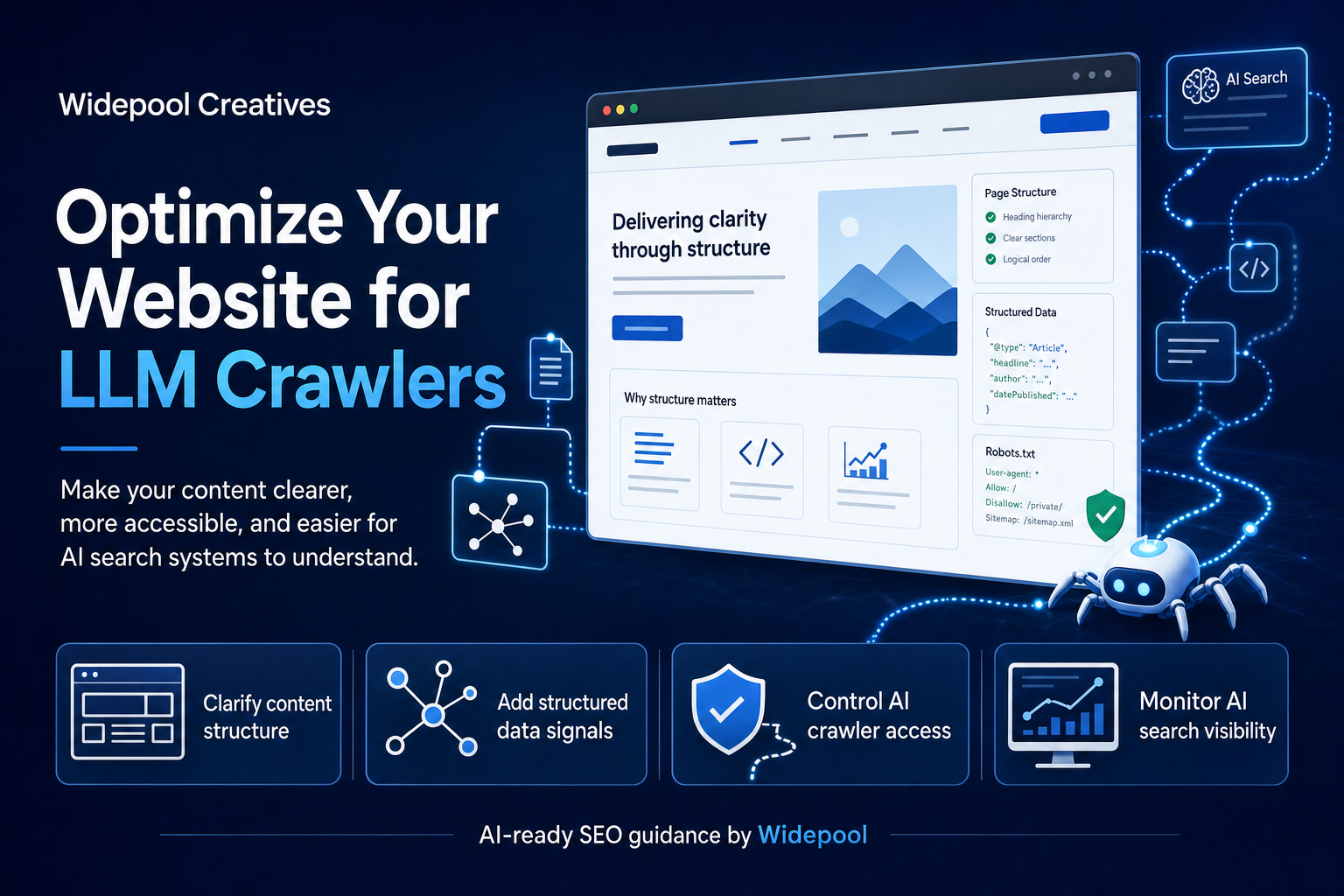
Did you know that over 60% of all internet traffic in 2024 is generated by bots—with large language model (LLM) crawlers and AI-powered search engines leading the way? As the digital landscape rapidly evolves, LLM crawler optimization is no longer an option—it’s a necessity for businesses that want visibility, leads, and long-term growth. If your website isn’t ready for AI crawlers like GPTBot or Google-Extended, you risk being invisible to the next generation of search engines.
At Widepool, we specialize in digital marketing and SEO services that not only prepare you for today’s search engines but also for the AI-driven future. This comprehensive guide walks you through actionable steps to optimize your website for LLM crawlers and AI search indexing, while demonstrating why Widepool is the partner you can’t afford to overlook.
What Is LLM Crawler Optimization And Why Does It Matter?
LLM crawler optimization refers to the process of making your website easily accessible, understandable, and indexable by large language model (LLM) crawlers—advanced AI bots that power AI search engines and chatbots. Unlike traditional search bots, these AI crawlers parse your content to generate direct answers, summaries, and knowledge cards for users.
- Visibility: AI search engines and chatbots increasingly rely on LLMs to answer queries directly from web content.
- Lead Generation: Optimized websites appear more frequently in AI-generated search snippets, driving high-quality leads.
- Future-proofing: The shift from keyword-based ranking to context, structure, and knowledge signals is already underway.
Failing to optimize means losing out on organic traffic, leads, and brand authority—often to competitors who have already embraced the AI-first era.
How Do LLM Crawlers Like GPTBot And Google-Extended Work?
LLM crawlers such as GPTBot (used by OpenAI’s ChatGPT) and Google-Extended (enabling content access for Google’s generative AI) are built to process massive volumes of content, extract relevant information, and deliver AI-powered answers. They use advanced natural language processing to understand not just keywords, but context, meaning, and relationships within your content.
- GPTBot: Specifically built to feed content into large language models like ChatGPT, GPTBot indexes and summarizes web data for conversational AI.
- Google-Extended: Allows website owners to control whether their content is used for Google’s generative AI and Search Generative Experience (SGE).
To thrive in AI search, your website must be optimized for these new crawling and indexing standards. That’s where Widepool’s expertise comes in.
How Can You Optimize Your Website For LLM Crawlers?
Optimizing for LLM crawlers and AI search indexing requires a mix of technical, structural, and content strategies. Start by implementing these core steps:
1. Ensure Clarity And Structure In Your Content
- Use clear, direct language: LLMs excel at parsing straightforward, well-organized text.
- Answer common questions: Structure content to provide concise answers to likely user queries, preferably in the first few sentences.
- Leverage headings and subheadings: Use descriptive H1, H2, and H3 tags so AI crawlers can easily segment and interpret your content.
- Bullet points and tables: Present lists, comparisons, or step-by-step instructions in bullet points or tables for easy parsing by AI.
2. Implement Structured Data Markup (Schema.org)
- Add BlogPosting, Organization, and relevant FAQ schema to your pages.
- Use JSON-LD format to help AI crawlers understand relationships, entities, and page purposes.
- Highlight business information, articles, and service offerings—this increases your chances of appearing in featured snippets and knowledge panels.
3. Update Your Robots.txt For AI
A crucial aspect of LLM crawler optimization is controlling which AI crawlers can access your content. Use robots.txt for AI to allow or disallow bots like GPTBot or Google-Extended.
| AI Crawler | User-agent | robots.txt Example |
|---|---|---|
| GPTBot | GPTBot |
User-agent: GPTBot |
| Google-Extended | Google-Extended |
User-agent: Google-Extended |
- To allow indexing, leave Disallow: blank.
- To block, specify the folders or files you want excluded.
4. Optimize For AI Search Indexing
AI search indexing depends on your site’s ability to communicate value, authority, and context to LLM crawlers. Here’s how to stand out:
- Maintain fresh, relevant content: Update your website regularly with accurate, up-to-date information.
- Use entity-based SEO: Clearly define people, places, products, and services using schema, internal links, and consistent terminology.
- Earn high-quality backlinks: Authority signals are even more important in the AI era.
- Optimize for mobile and speed: Fast, mobile-friendly pages improve crawlability and user experience.
5. Monitor And Adapt To AI Crawler Trends
- Track your log files and analytics for visits from AI crawlers including GPTBot, Google-Extended, and others.
- Stay up-to-date with AI search guidelines from Google, OpenAI, and leading AI platforms.
- Regularly audit your site for accessibility, crawlability, and content clarity.
Can SEO Really Boost Sales And Lead Generation In The AI Era?
Absolutely. SEO is a game changer—especially when optimized for AI-driven search. Websites that rank well in AI search engines attract qualified leads, build trust, and experience higher conversion rates. With LLM crawler optimization, your business can:
- Appear in AI-generated featured snippets and “People Also Ask” panels.
- Drive more organic traffic from both traditional and AI search engines.
- Generate more leads and close more sales by answering customer questions directly and effectively.
Widepool’s SEO services are designed to maximize these opportunities. Our team applies advanced strategies to ensure your website not only ranks higher but is also “understood” by AI crawlers in a way that benefits your bottom line.
Why Choose Widepool For LLM Crawler Optimization?
Widepool is a digital marketing powerhouse based in India, known for its expertise in AI-driven SEO, lead generation, and comprehensive web optimization. Here’s why businesses across India and beyond trust us:
- Proven expertise: Our team stays at the forefront of AI, search engine updates, and best SEO practices.
- Custom solutions: We tailor strategies to your business goals, industry, and audience.
- End-to-end support: From technical audits to content creation and ongoing monitoring, we handle everything.
- Transparent results: Detailed reporting and analytics so you see exactly how your investment drives growth.
Contact Widepool now:
- Fill in the contact form to request a free consultation.
- Call us at +91 9019676890 or +91 9986450820 for immediate assistance.
- Or send a WhatsApp message using the chat interface on our website. We’ll call you back and help you with all your digital marketing needs.
About Widepool
Widepool is a leading digital marketing and SEO agency based in India, specializing in LLM crawler optimization, AI search indexing, and growth-driven digital strategies. With a proven track record of helping businesses dominate both traditional and AI-based search, Widepool is your trusted partner for online visibility, leads, and sales.
- Find us on Facebook and Instagram
- Visit widepool.com for more information and success stories.
Frequently Asked Questions
What is LLM crawler optimization and why is it important?
LLM crawler optimization refers to the process of making your website more discoverable and understandable by large language model crawlers like GPTBot or other AI crawlers. As search and AI platforms increasingly rely on these crawlers to gather and index content for generative AI and answer engines, optimizing for them ensures your site’s information is accurately represented and easily accessible within AI search results.
How do AI crawlers like GPTBot and Google-Extended differ from traditional search engine crawlers?
AI crawlers such as GPTBot and Google-Extended are designed to collect vast amounts of content to train and power AI models, not just to index pages for keyword-based search. They analyze site structure, context, and semantics to improve AI search indexing and generative responses. Their crawling behavior, frequency, and the way they interpret your content can differ significantly from classic search engine bots.
What is robots.txt for AI and how should I configure it?
Robots.txt for AI allows you to control which parts of your site are accessible to AI crawlers. By specifying the user-agents for bots like GPTBot or Google-Extended, you can permit or restrict their access to sensitive or proprietary pages. Proper configuration helps you maintain privacy and compliance while allowing beneficial AI crawling for public content. Widepool offers guidance and templates to help you implement these controls effectively.
How does Widepool help optimize my website for AI search indexing?
Widepool provides comprehensive solutions for LLM crawler optimization, including technical audits, structured data enhancements, content strategy, and robots.txt for AI configuration. The platform helps ensure your site’s data is structured so AI crawlers can interpret it accurately, leading to improved visibility and representation in AI-powered search and answer engines.
Which AI crawlers should I be aware of when optimizing my website?
The most prominent AI crawlers currently include GPTBot (used by OpenAI), Google-Extended (used by Google for Bard and Gemini), and other bots associated with major AI and LLM initiatives. Monitoring your server logs and staying updated with industry news helps you identify new crawlers as they emerge. Widepool’s solutions are tailored to address the needs of all major AI crawlers.
What are the best practices for structuring content for AI crawlers?
To ensure AI crawlers can accurately understand and utilize your content, use semantic HTML, rich metadata, schema markup, and clear headings. Keep your content well-organized, concise, and focused on user intent. Widepool analyzes your current structure and recommends enhancements for better AI search indexing.
Can I control which of my website’s content is indexed by AI models?
Yes, you can use robots.txt for AI and relevant meta tags to instruct AI crawlers on what content to access or avoid. This gives you control over proprietary, sensitive, or confidential information. Widepool assists in configuring these settings to balance discoverability with privacy and compliance.
How often should I review and update my AI crawler optimization strategy?
As AI search and large language models evolve rapidly, it’s recommended to review your optimization strategy at least quarterly. Widepool provides ongoing monitoring and updates to ensure your site remains aligned with the latest LLM crawler guidelines and AI industry standards.
Does Widepool offer analytics to track AI crawler activity and impact?
Yes, Widepool delivers analytics and reporting on AI crawler visits, crawl frequency, and the impact on your site’s visibility within AI and generative search platforms. This data helps you fine-tune your LLM crawler optimization efforts and measure ROI.