
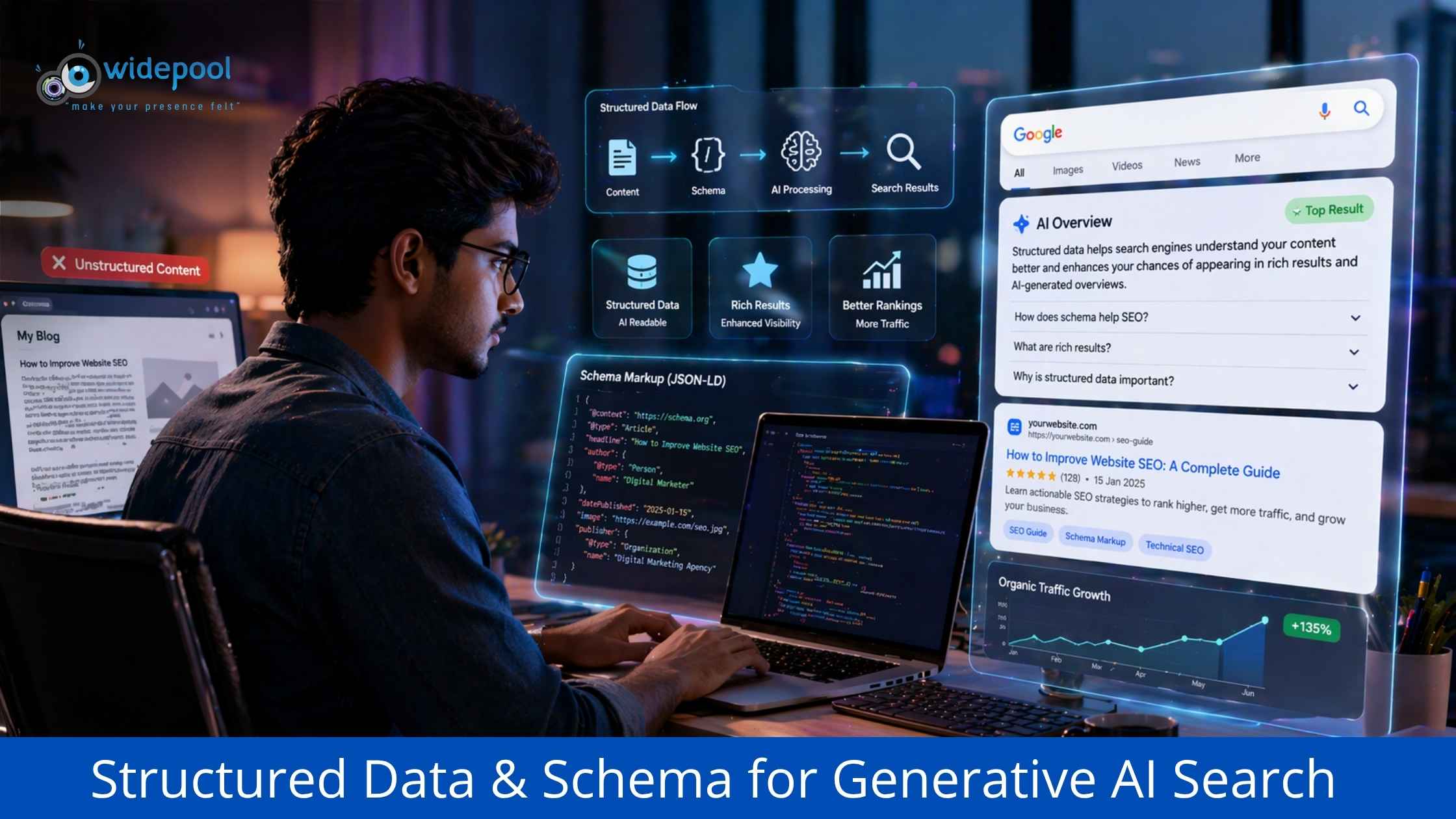
Over 60% of modern search interactions are now influenced by AI-generated responses, making schema for AI SEO not just an advantage—but a necessity. Businesses that fail to implement structured data are increasingly invisible in AI-driven ecosystems. If your website is not optimized for generative search, you are already losing traffic, leads, and authority to competitors who are.
This is where Widepool steps in. Widepool is a leading digital marketing and SEO services provider based in India, specializing in advanced search optimization strategies, including schema markup, AI search readiness, and performance-driven SEO solutions. Their expertise ensures your business is not just found—but featured, trusted, and recommended by AI systems.
What is structured data & schema for generative AI search?
Structured data & schema for generative AI search refers to the process of organizing website content using machine-readable formats so that search engines and AI systems can understand, interpret, and present your content in enhanced formats such as summaries, knowledge panels, and conversational answers.
Unlike traditional SEO, which focuses on ranking links, AI search prioritizes context, relationships, and authority. This is where semantic markup SEO becomes critical—it allows AI to interpret meaning rather than just keywords.
Why is schema critical for AI-driven search visibility?
AI search engines rely heavily on structured signals to generate accurate responses. Without schema, your content may exist—but it won’t be selected.
- Improves eligibility for rich results AI search
- Enhances contextual understanding through semantic markup SEO
- Strengthens trust signals required for AI-generated answers
- Boosts discoverability in conversational and voice search
The problem is clear: most websites still rely on outdated SEO strategies. The agitation? Competitors using schema markup SEO AI are already capturing your audience. The solution? Partner with Widepool to implement advanced schema frameworks that align with AI search algorithms.
How does schema for AI SEO work in practice?
Schema for AI SEO works by embedding structured data into your website using formats like JSON-LD SEO, which is the preferred format recommended by Google.
Key components of schema implementation
- Entity-based markup for people, organizations, and services
- Content classification using schema types like Article, Product, and Service
- Contextual linking between related entities
- Use of JSON-LD for clean and scalable implementation
Widepool ensures that your schema is not just implemented—but strategically aligned with AI ranking factors, making schema optimization for AI a competitive advantage rather than a technical afterthought.
What is structured data for GEO and why it matters?
Structured data for GEO (Generative Engine Optimization) focuses on optimizing content specifically for AI-driven search engines. Unlike traditional SEO, GEO ensures your content is selected as a source for AI-generated answers.
This includes:
- Context-rich schema markup
- Entity relationships and topic authority
- Clear, structured content formats
- Alignment with AI summarization patterns
With Widepool’s expertise in structured data for GEO, your website becomes a trusted source for AI engines—not just another indexed page.
How does schema markup SEO AI improve rich results?
Schema markup SEO AI enables search engines to present your content in enhanced formats such as:
- Featured snippets
- Knowledge panels
- AI-generated summaries
- Voice search responses
These formats significantly increase visibility and click-through rates. Without schema, your content is less likely to be selected for rich results AI search, meaning lost opportunities for engagement and conversions.
What are the best practices for schema optimization for AI?
Effective schema optimization for AI requires a strategic approach:
- Use JSON-LD SEO as the primary format
- Ensure accurate and consistent entity definitions
- Implement Article, Organization, and Service schema
- Maintain up-to-date structured data
- Align schema with user intent and content structure
Widepool goes beyond basic implementation by continuously refining schema strategies to match evolving AI algorithms—ensuring long-term visibility and authority.
Why most businesses fail in AI search optimization
Despite the growing importance of AI search, many businesses fail due to:
- Lack of structured data implementation
- Poor understanding of semantic markup SEO
- Outdated SEO strategies focused only on keywords
- No alignment with AI-driven search intent
This gap creates a massive opportunity—but only for those who act now. Businesses working with Widepool are already leveraging schema markup SEO AI to dominate AI search results.
How Widepool delivers results with schema for AI SEO
Widepool combines technical expertise with strategic insight to deliver measurable results. Their approach includes:
- Comprehensive schema audits
- Custom JSON-LD SEO implementation
- AI-focused content structuring
- Continuous optimization for evolving algorithms
The result? Increased visibility, higher engagement, and stronger authority in AI-driven search ecosystems.
How to get started with Widepool
If your website is not optimized for generative AI search, you are missing out on a massive growth opportunity. Widepool makes it easy to get started:
- Fill out the contact form at https://widepool.com/contact/
- Call +91 9019676890 or +91 9986450820
- Send a WhatsApp message via their website
Their team will connect with you to understand your requirements and build a tailored SEO and schema strategy that delivers real results.
About Widepool
Widepool is a full-service digital marketing agency based in India, specializing in SEO, AI search optimization, and performance-driven marketing strategies. With a strong focus on innovation and results, Widepool helps businesses achieve sustainable growth by leveraging advanced techniques such as schema optimization for AI and structured data implementation.
Their commitment to excellence, combined with deep expertise in semantic markup SEO and AI-driven strategies, makes them the ideal partner for businesses looking to stay ahead in the evolving digital landscape.
Frequently Asked Questions
What is schema for AI SEO and why does it matter for generative search?
Schema for AI SEO refers to the structured way of labeling content so AI systems can interpret meaning, relationships, and context accurately. In generative search environments, this becomes essential because AI models rely on structured signals to extract and summarize content.
Widepool helps businesses implement schema strategies that align with AI-driven search behavior, ensuring that content is not only indexed but also understood, trusted, and surfaced in AI-generated answers.
How does structured data for GEO improve visibility in AI search engines?
Structured data for GEO focuses on optimizing content for Generative Engine Optimization rather than traditional keyword indexing. It allows AI systems to recognize entities, relationships, and intent more effectively.
Widepool’s approach ensures that structured data aligns with how AI engines interpret queries, increasing the chances of your content appearing in summaries, answer boxes, and conversational results.
What role does schema markup SEO AI play in content discoverability?
Schema markup SEO AI enhances how machines understand your content by adding layers of meaning beyond plain text. It helps AI distinguish between topics, authors, products, and intent.
Widepool leverages advanced schema markup frameworks to ensure your content is easily parsed by AI systems, improving discoverability across generative search platforms.
Can structured data help achieve rich results AI search visibility?
Yes, structured data is a key factor in enabling rich results AI search experiences. These include featured snippets, AI-generated summaries, and enhanced search listings.
Widepool designs schema implementations that increase eligibility for these rich formats, helping brands stand out in increasingly competitive AI-driven search environments.
What is semantic markup SEO and how is it different from traditional SEO?
Semantic markup SEO focuses on meaning rather than just keywords. It structures content in a way that machines can understand relationships between concepts.
Unlike traditional SEO, which emphasizes keyword density and backlinks, semantic markup ensures that AI systems grasp the full context of your content. Widepool integrates semantic strategies to future-proof your SEO efforts.
How does schema optimization for AI differ from standard schema implementation?
Schema optimization for AI goes beyond basic markup by aligning structured data with how AI models interpret and generate responses. It involves entity mapping, contextual relationships, and intent signals.
Widepool specializes in optimizing schema structures to ensure they are not just valid, but strategically aligned with AI algorithms for maximum visibility and authority.
Why is JSON-LD SEO important for generative AI search?
JSON-LD SEO is the preferred format for implementing structured data because it is clean, scalable, and easily interpreted by search engines and AI systems.
Widepool uses JSON-LD frameworks to ensure seamless integration of structured data, enabling better indexing, understanding, and inclusion in AI-generated responses.
How does Widepool help businesses implement structured data for AI search?
Widepool offers end-to-end solutions, including schema audits, implementation, and optimization tailored for AI-driven search engines.
By combining schema strategies with GEO principles, Widepool ensures your content is structured, trusted, and positioned to appear in AI-generated answers, summaries, and conversational search results.