
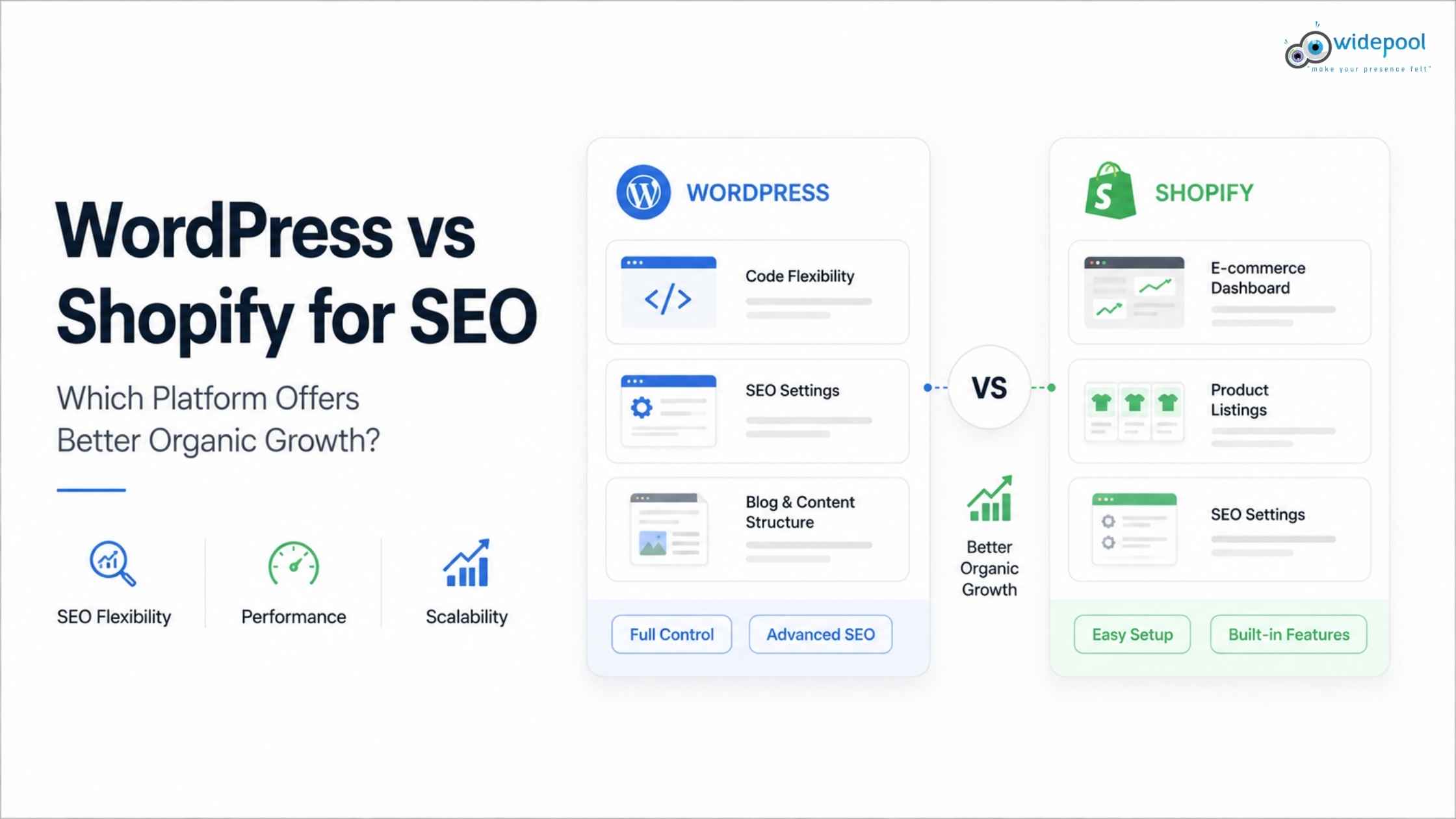
What Is The Real Difference Between WordPress And Shopify For SEO?
When evaluating WordPress vs Shopify for SEO, it’s crucial to know that over 40% of websites on the internet are powered by WordPress, while Shopify is the go-to platform for over 4.4 million ecommerce businesses worldwide. This stark difference isn’t just a number—it’s a testament to how these platforms have become the backbone of online business growth strategies. But which one truly delivers superior organic growth? At Widepool, we’ve guided hundreds of clients through this pivotal website platform selection journey, ensuring every decision aligns with their digital marketing ambitions and, most importantly, their search engine visibility.
Why Is SEO Platform Choice Critical For Organic Growth?
The platform you choose shapes your site’s SEO potential. A SEO friendly CMS can significantly enhance your ability to rank higher, attract more visitors, and convert leads into loyal customers. With Google’s ever-evolving algorithms, the technical foundation of your website matters as much as your content. Missing out on a well-optimized platform could mean losing valuable traffic and sales to your competitors. That’s why Widepool doesn’t just offer SEO services—we deliver a comprehensive growth strategy tailored to your business and market.
Ecommerce Platforms Comparison: Features That Impact SEO
Let’s start with an ecommerce platforms comparison focused on SEO-critical features:
- Customizable URLs: WordPress (with plugins like Yoast) offers granular control over URL structure, while Shopify has some fixed URL formats that may limit SEO flexibility.
- Meta Tags & Schema: WordPress SEO plugins allow extensive metadata and schema implementation; Shopify requires apps or manual updates.
- Site Speed: Shopify’s hosted infrastructure is fast by default; WordPress speed depends on hosting and optimization.
- Mobile Friendliness: Both platforms offer responsive themes, but Shopify’s are optimized out-of-the-box for ecommerce.
- Indexing Control: WordPress offers direct access to robots.txt and .htaccess for advanced SEO tweaks; Shopify limits these configurations.
The platform you select will directly affect your organic visibility. At Widepool, our team ensures that your chosen platform is fine-tuned for peak SEO performance, maximizing your ROI no matter which you pick.
How Does WordPress SEO Work For Organic Growth?
WordPress SEO is renowned for its flexibility and power, especially when combined with plugins like Yoast SEO, Rank Math, or All in One SEO. Here’s how WordPress gives your organic growth a boost:
- Total Content Control: WordPress lets you optimize every post, page, and category for keywords, meta descriptions, and schema markup.
- Plugins Galore: Thousands of plugins help automate sitemap creation, schema, redirects, and more.
- Advanced Blogging Capabilities: The platform’s origins as a blogging CMS make it perfect for content marketing and thought leadership, both crucial for SEO.
- Technical SEO: Direct access to core files allows for advanced tweaks, including canonical tags, robots instructions, and more.
However, WordPress requires careful maintenance—updates, security, and hosting configuration are your responsibility. That’s where Widepool’s team steps in to manage, optimize, and future-proof your WordPress website for maximum organic growth.
What Does Shopify SEO Offer For Ecommerce Stores?
Shopify SEO is engineered for simplicity and speed, making it an appealing choice for ecommerce entrepreneurs who want to focus on selling rather than technical details. Shopify’s strengths include:
- Automatic Sitemap and Robots.txt: Shopify generates these files, ensuring your products and pages are indexed efficiently.
- Mobile-Optimized Themes: All Shopify themes are designed for mobile shoppers, a crucial ranking factor.
- App Ecosystem: Shopify’s App Store offers SEO tools to optimize meta tags, image alt text, and structured data with minimal hassle.
- Fast, Secure Hosting: Shopify takes care of hosting and security, so your site loads quickly and stays protected—both vital for SEO.
On the flip side, Shopify’s restricted access to backend files can limit advanced SEO customizations. Widepool’s Shopify experts can help you overcome these limitations, leveraging every available tool and app to maximize your search visibility.
How To Choose The Best SEO Friendly CMS?
The choice between WordPress and Shopify often boils down to your business goals, technical skills, and growth ambitions. When considering a SEO friendly CMS, ask yourself:
- Is content marketing your primary growth channel? WordPress excels here.
- Is ecommerce your focus, requiring robust product management? Shopify is purpose-built for this.
- Do you need advanced customizations? WordPress offers more freedom; Shopify streamlines the basics.
- How hands-on can you be with maintenance? WordPress requires more, Shopify less.
Widepool specializes in aligning your business model with the ideal platform. We don’t just recommend a CMS—we analyze your industry, audience, and competition to ensure your SEO foundation supports your future growth.
Website Platform Selection: The Widepool Approach To Maximizing SEO Impact
At Widepool, website platform selection is a critical phase in our digital marketing process. Our experts conduct a comprehensive audit of your current site, assess your goals, and recommend the platform that will deliver sustainable organic growth. We don’t believe in one-size-fits-all; instead, we tailor every strategy to your unique needs, whether you’re scaling a content-powered business or launching a global ecommerce brand.
- Discovery & Audit: Deep dive into your business, competition, and existing digital assets.
- Strategy Development: Custom roadmap for platform migration or optimization, addressing technical SEO, content, and UX.
- Implementation: Flawless setup, optimization, and migration (if required) with zero downtime and maximum SEO retention.
- Ongoing Support & Analytics: Continuous optimization, reporting, and proactive improvements to keep you ahead of SEO trends.
Why settle for average growth when Widepool can unlock your site’s full potential? Our results-driven approach ensures you never lose out on organic traffic—or sales—by making the wrong platform choice.
Lead Generation: Why An Optimized Website Is Your Key To Success
Lead generation is the heartbeat of any online business. Without a search engine optimized website, you risk being invisible to your ideal customers. Widepool transforms your website into a lead-generation powerhouse by merging the best of technical SEO with persuasive, high-converting content. Our experience proves that businesses that invest in platform-appropriate SEO see up to 2x more inbound leads and 3x faster growth. Don’t let your competitors snatch up the leads you deserve—get proactive with Widepool.
How To Get Started With Widepool’s SEO Services
Ready to supercharge your organic growth? Widepool is your trusted partner in digital marketing and SEO. To explore our full suite of services:
- Fill out the form at https://widepool.com/contact/ for a free consultation.
- Call us directly at +91 9019676890 or +91 9986450820 to request a meeting.
- Send a WhatsApp message via the interface on our website for a quick callback.
Our team will contact you promptly to understand your needs and chart a custom strategy for your business. Don’t risk falling behind—contact Widepool and let us help you dominate your niche with results-driven SEO.
About Widepool
Widepool is a leading digital marketing and SEO services provider based in India, serving clients worldwide in sectors ranging from ecommerce to B2B and local businesses. With a relentless focus on results, transparency, and innovation, Widepool is your go-to partner for all things SEO, digital marketing, and platform optimization.
Frequently Asked Questions
What are the key SEO differences between WordPress and Shopify?
The main SEO differences between WordPress and Shopify stem from their flexibility and approach to customization. WordPress is an open-source SEO friendly CMS, offering greater control over technical SEO, URL structures, and plugin integrations, which can be vital for organic growth. Shopify SEO, on the other hand, is more streamlined and user-friendly but comes with some limitations, such as restricted control over certain metadata and URL formats. This makes WordPress generally more powerful for advanced SEO, while Shopify is better suited for those who want simplicity and ease.
Which platform is better for organic growth: WordPress or Shopify?
When comparing wordpress vs shopify for seo, WordPress typically provides more robust options for organic growth thanks to its extensive plugin library (like Yoast SEO and Rank Math) and high degree of customization. Shopify is engineered for ecommerce and is easier to set up, but may not match WordPress in technical SEO capabilities. However, Shopify’s built-in SEO features are sufficient for many merchants, especially those new to ecommerce.
How does Widepool assist with website platform selection for SEO?
Widepool specializes in helping businesses navigate website platform selection by conducting a detailed ecommerce platforms comparison tailored to your brand’s goals. Our experts evaluate your requirements, industry, and desired features to recommend whether WordPress SEO or Shopify SEO will yield the strongest organic growth for your business. We ensure that your chosen platform aligns with your long-term SEO and marketing strategy.
Is Shopify SEO sufficient for competitive ecommerce markets?
Shopify SEO offers essential tools for basic optimization—such as sitemaps, SSL, mobile responsiveness, and easy product management. However, in highly competitive ecommerce markets, you may encounter limitations regarding advanced technical SEO, structured data, and canonical URLs. Widepool helps bridge these gaps by implementing advanced strategies and recommending third-party apps to enhance your Shopify store’s SEO performance.
What are the advantages of using a SEO friendly CMS like WordPress?
A SEO friendly CMS like WordPress allows for granular control over every aspect of your site’s SEO, including custom meta tags, schema markup, clean URL structures, and fast loading times. WordPress also boasts a vast ecosystem of SEO plugins and themes, supporting both content-heavy and ecommerce websites. Widepool leverages these features to build customized WordPress SEO strategies that maximize organic visibility and growth.
Can Widepool migrate my site from Shopify to WordPress or vice versa with minimal SEO impact?
Yes, Widepool offers seamless migration services between Shopify and WordPress. We prioritize maintaining your existing SEO equity by carefully handling redirects, mapping URLs, and preserving on-page optimization. Our process ensures minimal traffic loss and helps you retain or improve your organic rankings during the transition.
How does Widepool optimize Shopify stores for better organic search results?
Widepool’s Shopify SEO experts enhance your store’s visibility by optimizing site structure, improving internal linking, speeding up load times, and implementing structured data. We also guide you in crafting optimized product descriptions and setting up Google Search Console and Analytics. For advanced requirements, we recommend and configure the best Shopify SEO apps to match your growth ambitions.
Does WordPress offer better long-term SEO scalability than Shopify?
For businesses aiming for long-term organic growth, WordPress generally offers greater SEO scalability due to its flexibility, vast plugin support, and open-source nature. As your site and SEO strategy evolve, you can implement custom features and integrations not always possible on Shopify. Widepool helps you harness this scalability, ensuring your WordPress site can grow dynamically with your brand.
How does Widepool approach ecommerce platforms comparison for clients?
Widepool’s ecommerce platforms comparison process involves a holistic analysis of your business needs, SEO priorities, budget, and growth targets. We evaluate WordPress and Shopify (as well as other major platforms) based on SEO capabilities, usability, and scalability to provide a clear recommendation. Our goal is to ensure you select the platform that will deliver sustainable organic growth and align with your digital strategy.