
Did you know? Research shows that over 60% of modern websites use JavaScript frameworks like React, Angular, or Vue, but only 53% of their important content is reliably indexed by Google. If your business depends on leads from search engines, your site’s rendering strategy can make or break your results. In this guide, Widepool reveals how choosing between dynamic rendering vs hybrid rendering can be the SEO game-changer your business needs.
What Is The Difference Between Dynamic Rendering And Hybrid Rendering?
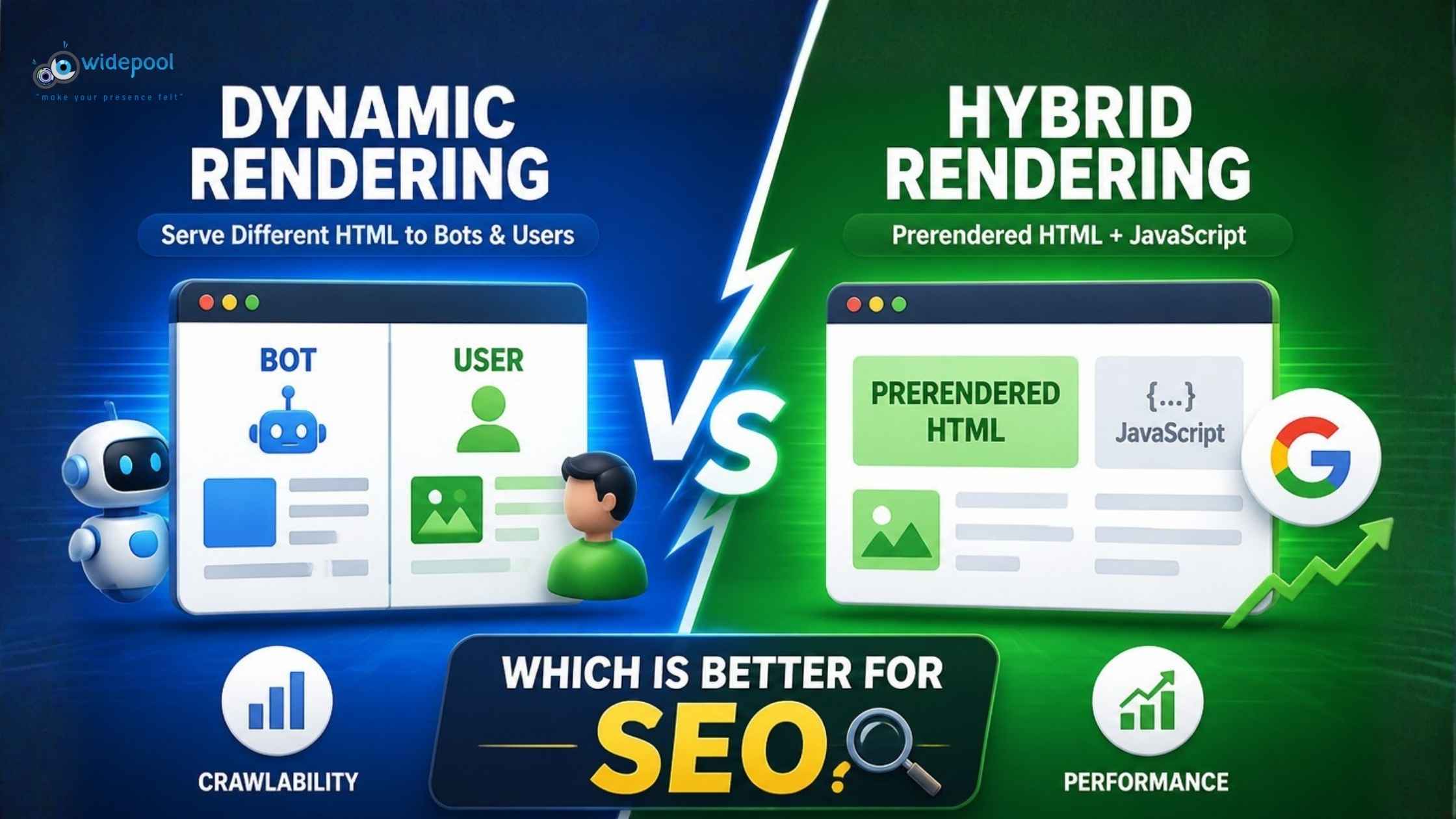
Dynamic rendering and hybrid rendering are two advanced rendering strategies used to help search engines like Google and Bing effectively crawl and index modern JavaScript-driven websites.
- Dynamic rendering: Detects when a search engine bot requests a page and serves a pre-rendered HTML snapshot, while human users get the regular JavaScript version.
- Hybrid rendering: Combines server-side rendering with client-side JavaScript, providing fast, SEO-friendly HTML for all users and bots, but still allowing rich interactivity on the frontend.
Both approaches aim to solve the challenge of JavaScript SEO and ensure that your site’s content is visible, crawlable, and indexable. But which one is best for your business? Let’s break down the details.
Why Is Rendering Strategy Critical For SEO?
Rendering strategy determines how your website content is delivered and interpreted by both users and search engines. If your site relies on heavy JavaScript but doesn’t implement the right rendering strategy, search engines may not be able to access your key content, leading to poor rankings and missed business opportunities.
- Proper rendering ensures search engines can access, crawl, and index your content.
- Improper rendering can hide your products, services, or lead forms from Google, putting your site at a severe disadvantage.
At Widepool, we see firsthand how businesses lose out on valuable organic search traffic due to outdated or incorrect rendering strategies.
How Does Dynamic Rendering SEO Work?
Dynamic rendering SEO is all about serving different content to bots and users. When Googlebot visits your site, a dynamic renderer detects the bot and delivers a fully rendered HTML version. Regular users, by contrast, get the normal JavaScript experience.
- Reduces crawling JavaScript issues: Google and Bing see fully rendered pages, avoiding problems where bots can’t process heavy scripts quickly enough.
- Speeds up indexing: Search bots can index content faster since they don’t need to execute JavaScript on the fly.
- Ideal for frequently updated, content-rich sites: News portals, e-commerce catalogs, and SaaS dashboards benefit greatly.
However, setting up dynamic rendering is not trivial. It requires robust infrastructure, constant monitoring, and updates to match your site’s changes. That’s why Widepool’s SEO specialists carefully assess your site’s needs before recommending this approach.
How Does Hybrid Rendering SEO Work?
Hybrid rendering SEO combines the best elements of server rendering and client-side hydration. Every visitor—whether human or bot—receives an initial HTML page rendered on the server. Then, client-side JavaScript takes over to enable interactivity.
- Delivers consistent content to all: There’s no risk of search engines seeing something different from users.
- Improves site speed and Core Web Vitals: Server rendering delivers “first paint” faster, which is a ranking factor.
- Ensures modern app-like experiences: After the initial load, your site remains interactive and dynamic.
Hybrid rendering is often the preferred choice for businesses that want both SEO performance and rich user experiences, such as fintech, education, and logistics platforms.
Dynamic Rendering Vs Hybrid Rendering: A Quick Comparison Table
| Factor | Dynamic Rendering | Hybrid Rendering |
|---|---|---|
| How it works | Bots get pre-rendered HTML, users get JavaScript | Both bots and users get server-rendered HTML, then JavaScript |
| SEO benefits | Guaranteed indexability, quick fixes for JS-heavy sites | Improved speed, consistency, and robust SEO |
| Implementation | Requires bot detection and rendering infrastructure | Requires server-side rendering capabilities |
| Best for | Large, complex, or legacy JavaScript sites | Modern web apps needing both SEO and rich UX |
| Challenges | Maintenance overhead, possible bot/user mismatch | Higher initial development, requires server resources |
What Are The Common Pitfalls In Crawling JavaScript?
Crawling JavaScript is one of the biggest challenges for search engines. Googlebot has improved at executing JavaScript, but it’s still not perfect. Here are common pitfalls Widepool helps you avoid:
- Delayed content rendering: If key content loads only after heavy scripts run, search engines may miss it.
- Blocked resources: If robots.txt blocks scripts or APIs, your content won’t be indexed.
- Infinite scroll or lazy loading mishaps: Bots may not trigger user actions needed to load content.
These issues can lead to lower rankings, incomplete indexing, and missed conversions. Widepool’s experts use advanced tools to diagnose and resolve JavaScript SEO challenges, ensuring every important page is crawled and ranked.
Why Is Server Rendering Essential For Modern Websites?
Server rendering sends a fully-formed HTML page to the browser, making it instantly accessible to both users and search engines. This approach is crucial for:
- Improving first contentful paint (FCP): Faster display of meaningful content boosts user experience and SEO scores.
- Ensuring accessibility: All users—including those with older devices or slow connections—see your content without delay.
- Maximizing shareability: Social media platforms and messaging apps can easily generate rich previews from server-rendered HTML.
Widepool’s developers and SEOs work together to implement server rendering in a way that balances speed, scalability, and SEO impact.
How To Choose The Best Rendering Strategy For Your Website?
Here’s a step-by-step approach Widepool uses to determine the right SEO rendering strategy for your business:
- Audit your site’s current rendering and SEO status using advanced tools.
- Analyze your audience and content: Do you need real-time updates, or is static content sufficient?
- Assess technical resources and budget: Can your team maintain a dynamic renderer, or is hybrid/server rendering more sustainable?
- Implement the chosen strategy and monitor its impact on crawling, indexing, and rankings.
- Continuously optimize as your site and Google’s algorithms evolve.
If you’re unsure, Widepool can help you select and implement the perfect rendering strategy tailored to your growth goals.
Why Widepool Is Your Trusted Partner For SEO Rendering Success
Widepool is a leading digital marketing agency based in India, specializing in advanced SEO services for businesses of all sizes. Our team combines deep technical expertise, proven experience, and a client-first approach to deliver measurable results.
- Technical mastery: We stay ahead of the curve with the latest in dynamic rendering, hybrid rendering, and server rendering techniques.
- Full-scope SEO: From technical audits to content and link building, we cover every aspect of search engine optimization.
- Lead generation focus: Our strategies are designed not just to increase traffic, but to generate real business leads and sales.
- Transparent reporting: You’ll always know how your site is performing and where your ROI is coming from.
With Widepool, you gain a partner who is invested in your long-term digital growth.
About Widepool
Widepool is an award-winning digital marketing and SEO solutions provider headquartered in India. We empower businesses with cutting-edge strategies for search engine visibility, lead generation, and sustainable online growth. Our team is passionate about helping you succeed—whether you’re a startup or a large enterprise. Call us, WhatsApp us, or fill out our contact form to get started.
Frequently Asked Questions
What is the difference between dynamic rendering and hybrid rendering for SEO?
Dynamic rendering vs hybrid rendering is a common point of confusion for website owners focused on organic visibility. Dynamic rendering works by serving pre-rendered static HTML to bots while users get the regular JavaScript-powered site. Hybrid rendering, on the other hand, combines server-side rendering for critical content and client-side rendering for interactive parts, benefiting both users and search engines. Hybrid rendering SEO strategies typically provide better performance, improved crawlability, and a seamless user experience compared to solely dynamic rendering SEO approaches.
Why is rendering strategy important for modern websites?
Choosing the right rendering strategy directly impacts how search engines and users experience your site. With so much content powered by JavaScript, a robust approach ensures your pages are correctly indexed, loads are fast, and no content is hidden from search engine bots. Optimizing your rendering strategy is key for JavaScript SEO, user engagement, and maintaining competitive rankings in search results.
How does Widepool address JavaScript SEO challenges?
Widepool provides solutions tailored to sites with heavy JavaScript usage. By implementing advanced server rendering techniques, Widepool ensures that search engine bots receive fully rendered HTML, eliminating the risk of missing content or poor indexing. This approach reduces issues from crawling JavaScript and enhances overall JavaScript SEO performance, ensuring your critical content is always visible to search engines.
What are the SEO benefits of hybrid rendering compared to dynamic rendering?
Hybrid rendering SEO offers several advantages. It enables faster initial page loads, improved user experience, and better indexability by search engines. Unlike dynamic rendering SEO, which may only benefit bots, hybrid rendering ensures both users and bots see optimized, content-rich pages. Widepool recommends hybrid solutions for businesses seeking a future-proof, scalable approach to rendering.
Does Widepool support both server rendering and client-side rendering?
Yes. Widepool’s platform leverages server rendering for SEO-critical content while preserving interactive features with efficient client-side rendering. This best-of-both-worlds approach aligns with hybrid rendering SEO best practices and ensures users and search engines receive the optimal experience.
How does Widepool streamline crawling JavaScript-heavy websites?
Crawling JavaScript can be resource-intensive and unreliable for search engines. Widepool simplifies this by serving pre-rendered HTML to bots, removing the need for them to execute complex scripts. This greatly reduces rendering errors and ensures that all vital content, metadata, and structured data are accessible for crawling and indexing.
Can Widepool help improve Core Web Vitals and page speed?
Absolutely. By leveraging hybrid and server rendering, Widepool reduces time-to-content, improves Largest Contentful Paint (LCP), and minimizes layout shifts. These improvements translate into better Core Web Vitals scores, enhanced user satisfaction, and a direct SEO boost.
When should I choose dynamic rendering vs hybrid rendering for my website?
Dynamic rendering is suitable for sites where only bots need pre-rendered content, but it can lead to different experiences for users and search engines. Hybrid rendering is recommended for most modern web applications as it delivers SEO benefits and a seamless user experience. Widepool helps assess your needs to recommend the best rendering strategy for your technical stack and business goals.
Does Widepool integrate with popular frameworks for rendering optimization?
Yes, Widepool integrates with frameworks like React, Vue, Angular, and Next.js. Our solutions adapt to your existing tech stack to enable efficient server rendering and hybrid rendering SEO enhancements, ensuring both users and search engines receive the best possible experience.