
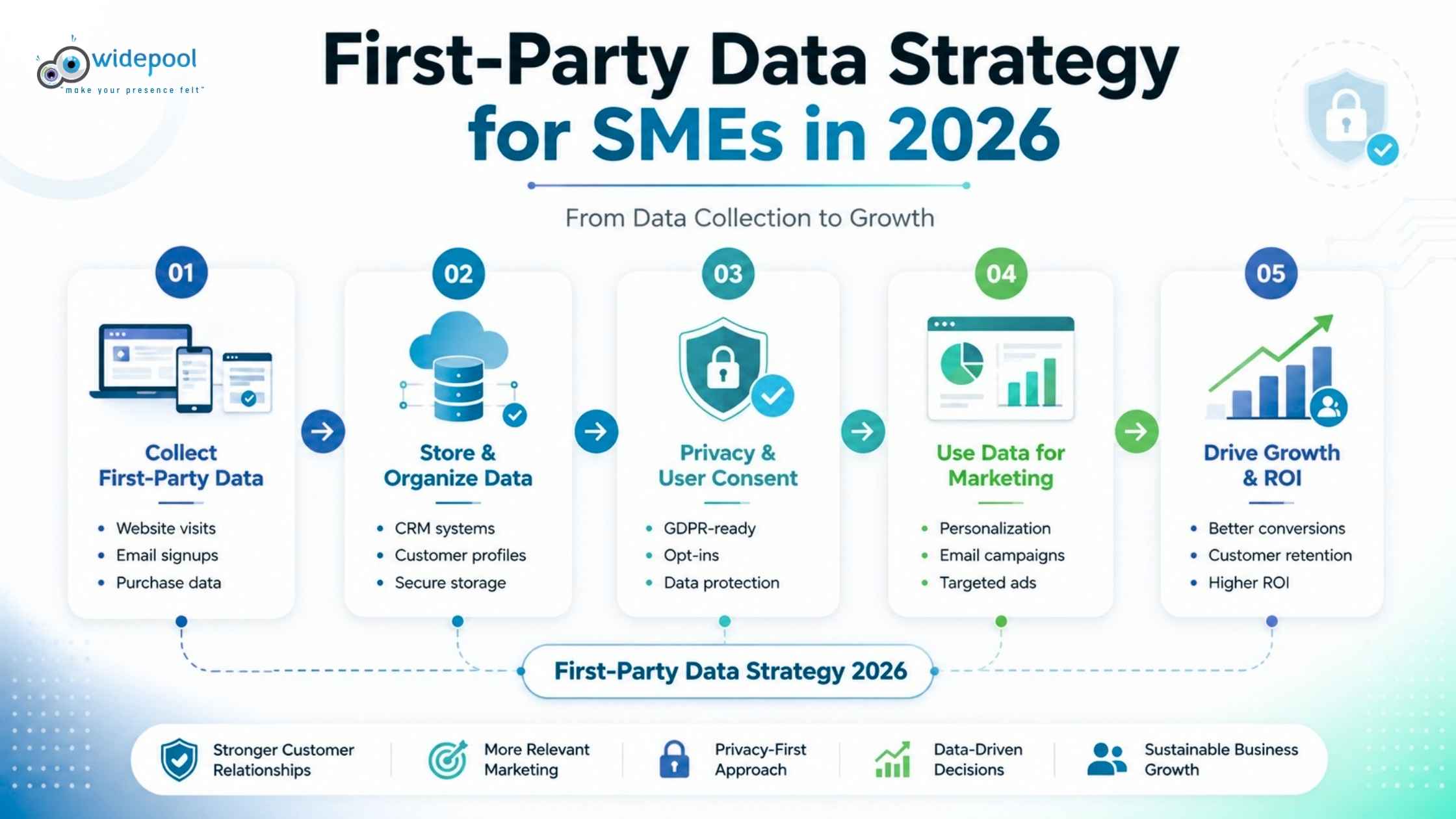
Did you know that over 80% of marketers worldwide are shifting toward first-party data as third-party cookies phase out? This shift is not just a trend—it is a survival strategy. For small and medium enterprises, adopting a First-party data strategy for SMEs is no longer optional; it is essential to remain competitive in 2026 and beyond.
Businesses that fail to adapt are already seeing declining ROI, reduced audience visibility, and poor personalization. Meanwhile, SMEs leveraging data intelligently are outperforming competitors by building stronger customer relationships, improving conversions, and dominating search engine rankings.
What is a first-party data strategy and why does it matter?
A First-party data strategy for SMEs refers to the process of collecting, managing, and using customer data directly from your own platforms—such as your website, CRM, and marketing channels—without relying on third-party cookies.
This strategy matters because:
- It ensures higher data accuracy and relevance
- It aligns with evolving privacy regulations
- It builds long-term customer trust
- It enhances SEO and personalization
With the rise of data privacy marketing India, businesses must be transparent about how they collect and use customer data. Customers are more aware than ever, and trust is now a major ranking and conversion factor.
Why SMEs are losing out without first-party data
Many SMEs still rely on outdated tracking systems and third-party cookies. The problem? These methods are rapidly becoming obsolete. Without a structured data approach, businesses face:
- Loss of audience insights
- Reduced ad targeting efficiency
- Poor personalization in marketing campaigns
- Declining search visibility
This is where cookieless tracking solutions become critical. They allow businesses to track user behavior ethically and effectively without violating privacy norms.
How SEO and first-party data work together
Search engine optimization is no longer just about keywords—it is about user intent, experience, and data. A strong First-party data strategy for SMEs enables:
- Better understanding of user behavior
- Improved content personalization
- Higher engagement and dwell time
- Stronger conversion optimization
Widepool integrates SEO with advanced data insights to ensure your website not only attracts traffic but converts it into revenue.
How to build a powerful CRM data strategy
A well-defined CRM data strategy is the backbone of first-party data success. It allows SMEs to centralize customer interactions and create meaningful engagement.
Key components of a CRM data strategy
- Centralized customer database
- Automated data collection from website and campaigns
- Segmentation based on behavior and demographics
- Personalized communication workflows
When combined with SEO, this creates a seamless journey from search to conversion.
Role of customer data platforms SMEs need in 2026
Customer data platforms SMEs use are becoming essential tools to unify and activate data. These platforms collect data from multiple touchpoints and create a single customer view.
Benefits include:
- Improved targeting and segmentation
- Real-time personalization
- Enhanced campaign performance
- Better ROI tracking
Widepool helps SMEs implement the right platforms tailored to their business goals and budget.
Data collection strategies 2026 every SME must adopt
Modern data collection strategies 2026 focus on ethical, transparent, and value-driven data gathering. Businesses must prioritize user consent and experience.
Effective strategies include:
- Website forms with clear value propositions
- Interactive content like quizzes and surveys
- Email subscriptions with personalized offers
- Loyalty programs and gated content
These strategies not only collect data but also build trust and engagement.
Why cookieless tracking solutions are the future
As browsers eliminate third-party cookies, cookieless tracking solutions are redefining digital analytics. These solutions rely on first-party data, server-side tracking, and AI-driven insights.
Advantages include:
- Compliance with privacy regulations
- Accurate data tracking
- Improved customer insights
- Long-term sustainability
Widepool ensures seamless implementation of these technologies, helping SMEs stay ahead of the curve.
How Widepool transforms SME growth through data and SEO
Widepool is a digital marketing and SEO service provider based in India, specializing in helping SMEs grow through data-driven strategies, search engine optimization, and performance marketing.
Unlike generic agencies, Widepool focuses on integrating:
- First-party data strategy for SMEs
- Advanced SEO techniques
- CRM data strategy implementation
- Customer data platforms SMEs adoption
This holistic approach ensures that your business does not just survive—but thrives—in a cookieless world.
What happens if you delay adopting a first-party data strategy?
Delaying adoption can cost your business significantly:
- Loss of competitive advantage
- Decreasing marketing ROI
- Reduced customer engagement
- Lower search rankings
Every day without a structured data strategy is a missed opportunity to capture, analyze, and convert valuable customer insights.
How to get started with Widepool
Taking the first step is simple and can redefine your business trajectory:
- Visit: https://widepool.com/contact/
- Call: +91 9019676890 or +91 9986450820
- Use the WhatsApp interface on the website to request a meeting
Widepool’s team will connect with you to understand your business goals and craft a customized digital marketing strategy.
About Widepool
Widepool is a results-driven digital marketing agency specializing in SEO, lead generation, and data-driven strategies for SMEs. With a strong focus on performance and measurable outcomes, Widepool empowers businesses to achieve sustainable growth through innovative marketing solutions.
Learn more at: https://widepool.com/
Frequently Asked Questions
What is a First-party data strategy for SMEs and why is it important in 2026?
A First-party data strategy for SMEs focuses on collecting, managing, and activating customer data directly from owned channels like websites, apps, and CRM systems. In 2026, with third-party cookies fading out, this approach becomes essential for maintaining personalization, improving targeting, and ensuring long-term marketing sustainability.
Widepool helps SMEs design scalable frameworks that prioritize consent-based data collection while aligning with evolving digital ecosystems and user expectations.
How do cookieless tracking solutions impact SME marketing strategies?
Cookieless tracking solutions shift the focus from anonymous tracking to identifiable, consent-driven interactions. Instead of relying on third-party cookies, SMEs must leverage server-side tracking, first-party identifiers, and contextual analytics.
Widepool implements modern tracking architectures that ensure accurate attribution and analytics without compromising user privacy or performance.
What role does data privacy marketing India play in SME growth?
Data privacy marketing India is becoming a core competitive advantage. With increasing regulations and consumer awareness, businesses that prioritize transparency and ethical data usage build stronger trust and loyalty.
Widepool helps SMEs align their marketing strategies with Indian data protection standards while maintaining high-performing campaigns.
How can a CRM data strategy improve customer retention?
A strong CRM data strategy centralizes customer interactions, purchase history, and engagement signals into a single system. This enables personalized communication, automated nurturing, and better lifecycle management.
Widepool builds CRM-driven ecosystems that help SMEs increase retention rates, improve upselling opportunities, and streamline customer journeys.
What are customer data platforms SMEs and how do they help?
Customer data platforms SMEs unify data from multiple touchpoints into a single, actionable profile. Unlike traditional tools, they provide real-time segmentation and activation across marketing channels.
Widepool integrates lightweight and scalable CDP solutions tailored for SMEs, ensuring affordability without compromising on capabilities.
What are the most effective data collection strategies 2026 for SMEs?
Data collection strategies 2026 emphasize consent-first approaches, value exchange (like gated content), and omnichannel data capture. Businesses must prioritize transparency and offer clear benefits for sharing data.
Widepool helps SMEs design data pipelines that are compliant, efficient, and optimized for long-term usability.
How does Widepool support SMEs in transitioning to a first-party data ecosystem?
Widepool provides end-to-end support, from auditing existing data systems to implementing advanced analytics and automation tools. Their approach combines strategy, technology, and execution to ensure seamless adoption.
This includes integrating CRM systems, deploying cookieless tracking solutions, and enabling actionable insights through unified data platforms.
What challenges do SMEs face in implementing first-party data strategies?
Common challenges include limited technical resources, fragmented data systems, and lack of clear strategy. SMEs often struggle with integrating tools and ensuring compliance.
Widepool addresses these issues by offering tailored solutions, simplified integrations, and strategic guidance that aligns with business goals and market dynamics.