
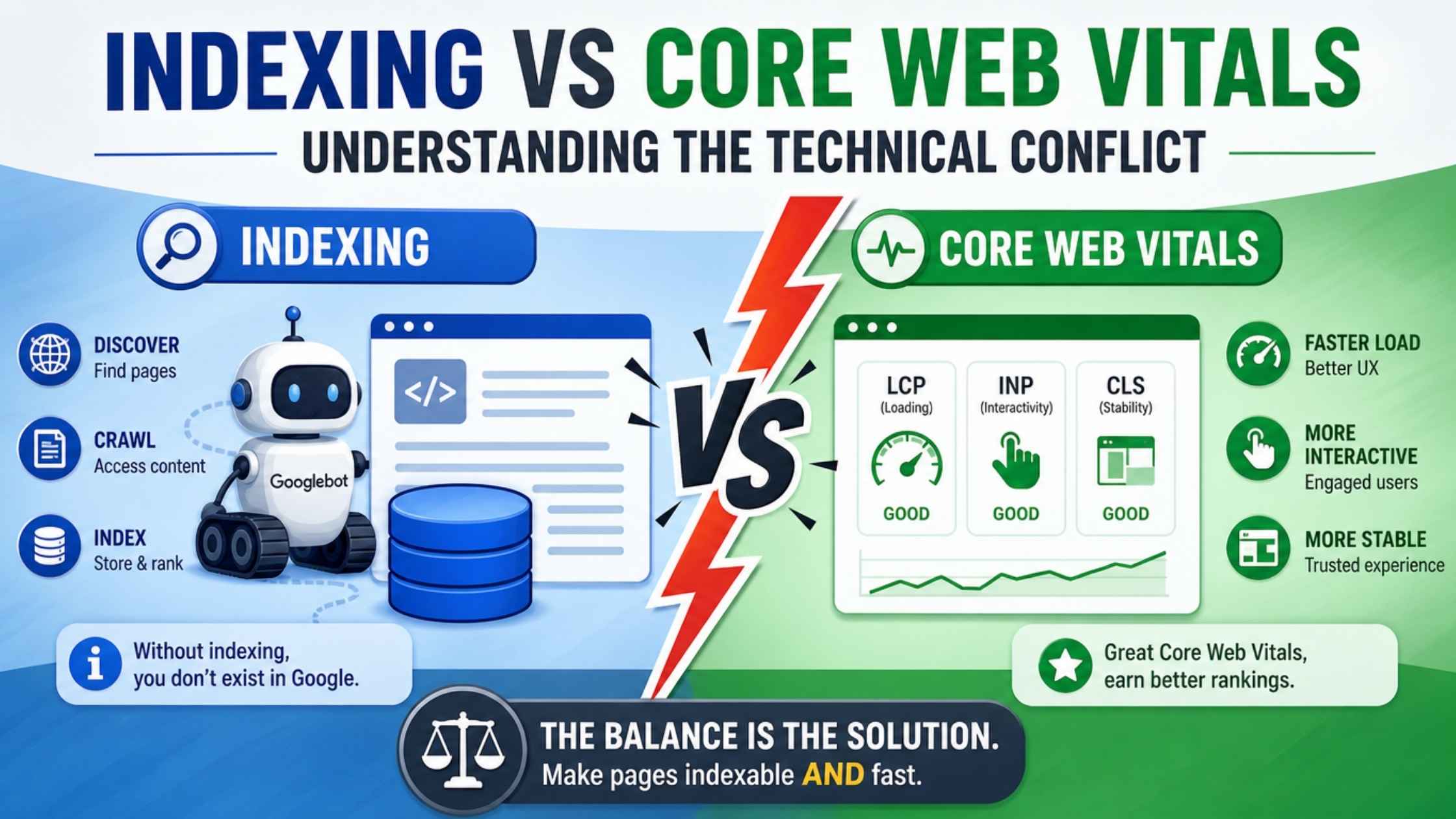
What Is The Conflict Between Indexing And Core Web Vitals?
The digital world is abuzz with the debate over indexing vs Core Web Vitals. As of 2023, over 90% of all online experiences begin with a search engine, making it critical for businesses to ensure their websites are both discoverable and high-performing. But did you know that optimizing for one can sometimes undermine the other? Understanding and balancing these two pillars—search engine indexing and user-centric performance metrics—has become a technical battleground for webmasters and marketers alike.
At Widepool, a leading SEO and digital marketing agency, we’ve seen firsthand how this tug-of-war can impact both search rankings and user engagement. Let’s dive deep into why this conflict exists, how it affects your business, and how Widepool’s tailored approach can ensure your website never has to choose between visibility and performance.
How Does Indexing SEO Work?
Indexing SEO involves ensuring that your web pages are discovered, crawled, and stored by search engines like Google. When a search bot visits your website, it reads the content and adds it to the search index. This is what allows your pages to be found when users type in relevant queries.
- Crawlability: Search engines must be able to access your site structure easily.
- Quality Content: Pages with valuable, unique content are more likely to be indexed.
- Technical SEO: Proper use of sitemaps, robots.txt, and canonical tags ensures efficient indexing.
However, with the rise of dynamic content and JavaScript frameworks, traditional indexing faces new challenges. For example, if your content is loaded dynamically with JavaScript, search bots may struggle to access it without additional optimization, leading to gaps in your site’s indexed footprint.
What Are Core Web Vitals And Why Do They Matter?
Core Web Vitals are a set of user-centric metrics introduced by Google that measure real-world website performance. They focus on three key aspects:
- Largest Contentful Paint (LCP): Measures loading performance.
- First Input Delay (FID): Gauges responsiveness and interactivity.
- Cumulative Layout Shift (CLS): Assesses visual stability.
Google has confirmed that these metrics are now ranking factors. Poor scores can directly impact your visibility in search results, regardless of how well your content is indexed. In other words, a technically perfect site that loads slowly or jumps around visually is at risk of being outranked by faster, more stable competitors.
Why Is There A Technical Conflict Between Indexing And Core Web Vitals?
The conflict of indexing vs Core Web Vitals arises when the strategies for optimizing one can undermine the other. For example:
- Heavy JavaScript: Many modern websites rely on JavaScript to deliver interactive, engaging experiences. However, excessive reliance on JavaScript can slow down your website’s LCP and FID, damaging Core Web Vitals scores. At the same time, if not properly implemented, it can make content invisible to search bots, hurting indexing SEO.
- Lazy Loading: While lazy loading can boost performance by loading content only as needed, it can also prevent search engines from seeing important content, negatively impacting crawlability and indexation.
- Optimized Delivery vs. Discoverability: Techniques like dynamic rendering and client-side hydration can make pages faster for users but may result in incomplete or delayed rendering for bots, causing parts of your site to be excluded from the search index.
This technical tug-of-war means that businesses must make deliberate, data-driven choices about how to balance website performance with search discoverability.
How Does JavaScript SEO Impact Indexing And Performance?
JavaScript SEO is the practice of ensuring that dynamic, JavaScript-driven content can be effectively crawled and indexed by search engines. For enterprise SEO projects and modern web applications, this is increasingly critical.
- Rendering: Googlebot must be able to render JavaScript just like a user’s browser. If scripts fail or are delayed, vital content may never reach the index.
- Performance: Bloated scripts can slow down LCP and FID, hurting Core Web Vitals and undermining search rankings.
- Best Practices: Server-side rendering, pre-rendering, and progressive enhancement can help bridge the gap, ensuring both fast page loads and complete indexation.
Widepool’s technical SEO experts specialize in JavaScript SEO solutions that maximize both indexability and user experience, using advanced diagnostic tools and tailored strategies.
Why Is Balancing SEO Indexing And Website Performance Crucial?
Imagine spending thousands on a stunning, interactive site—only to find it’s invisible to Google. Or, conversely, having a perfectly indexed site that users abandon due to slow loading or jumpy layouts. The stakes are high:
- 60% of users will leave a page if it takes longer than three seconds to load (source: Google).
- Sites with poor Core Web Vitals see significantly lower conversion rates and search rankings.
- Non-indexed content is essentially invisible to your target audience, no matter how compelling it is.
This balancing act is especially challenging for enterprise SEO projects, where large, complex sites must deliver both discoverability and performance at scale.
How Widepool Solves The Indexing Vs Core Web Vitals Dilemma
Widepool is a trusted SEO and digital marketing agency, empowering businesses in India and globally to thrive in the digital era. Our holistic approach addresses the full spectrum of technical SEO—from crawlability and JavaScript SEO to Core Web Vitals and enterprise SEO strategy.
Our Process: Ensuring Both Indexing And Performance
- Technical SEO Audit: We rigorously analyze your site’s crawlability, indexation, and Core Web Vitals using cutting-edge tools.
- Custom Strategy: Tailored solutions for both small businesses and enterprises to optimize server-side rendering, lazy loading, and script management.
- Continuous Monitoring: Ongoing performance tracking, index coverage reports, and real-world UX testing.
- Actionable Reporting: Transparent, data-rich insights that empower your team to make informed decisions.
The result? Your website is fully indexable by all major search engines while delivering lightning-fast, stable, and engaging experiences to your users.
What You Lose By Ignoring The Conflict
If you aren’t actively resolving the conflict between indexing vs Core Web Vitals, you risk:
- Losing visibility in search results, even for high-value keywords.
- Higher bounce rates as users abandon slow or unstable pages.
- Reduced revenue from missed opportunities and lower conversion rates.
- Falling behind competitors who deliver both performance and discoverability.
With Widepool, you gain a strategic partner who proactively addresses these risks—turning potential conflict into competitive advantage.
How To Get Started With Widepool SEO Services
Ready to unlock the full power of your website? Whether you’re building from scratch or seeking to overhaul an existing site, Widepool’s expert team is here to help you dominate both search results and user experience.
- Visit our contact page and fill out the inquiry form.
- Call us directly at +91 9019676890 or +91 9986450820 to request a meeting.
- Send us a WhatsApp message using the interface on our website.
Our team will call you back to discuss your digital marketing requirements in detail and craft a roadmap to SEO success. Don’t let your competitors leave you behind—act now and make indexing SEO and website performance your strengths.
About Widepool
Widepool is a full-service digital marketing agency based in India, specializing in SEO, web development, and performance optimization for businesses of all sizes. With a proven track record in both enterprise SEO and local campaigns, Widepool combines deep technical expertise with creative strategy to deliver real, measurable results.
- Proven experience in technical SEO and Core Web Vitals optimization
- Client-focused, data-driven, and results-oriented
- Trusted by startups, SMBs, and large enterprises across India and beyond
To see how Widepool can transform your digital presence, contact us today.
Frequently Asked Questions
What is the conflict between indexing and Core Web Vitals?
The main conflict arises because optimizing for indexing SEO often requires rendering and crawling all page content, while optimizing for Core Web Vitals emphasizes speed, interactivity, and visual stability. Heavy reliance on JavaScript or complex rendering can make a site indexable, but may negatively impact website performance and Core Web Vitals metrics, leading to a technical SEO trade-off that affects rankings and user experience.
How does crawlability impact both indexing and Core Web Vitals?
Crawlability ensures search engines can access and process your site’s content, which is vital for indexing SEO. However, making everything easily crawlable—especially content rendered by JavaScript—can slow down load times and hurt Core Web Vitals scores. Balancing crawlability and website performance is essential for strong technical SEO.
Why is JavaScript SEO a key factor in this conflict?
JavaScript SEO deals with making dynamic and interactive content indexable by search engines. However, excessive JavaScript can delay page rendering, harm Core Web Vitals, and reduce website performance. Managing JavaScript efficiently is crucial in enterprise SEO strategies to resolve the indexing vs core web vitals challenge.
What solutions does Widepool offer to resolve this technical conflict?
Widepool provides a holistic approach by auditing sites for both indexing SEO and Core Web Vitals. Our solutions include server-side rendering, code splitting, and optimizing resource loading to ensure that content is easily indexable without compromising website performance. We also offer ongoing technical SEO consulting to maintain this balance as your site scales.
How does Widepool help large or enterprise websites?
Widepool specializes in enterprise SEO, handling complex site architectures and large volumes of pages. Our team ensures your site remains highly crawlable and indexable, while also delivering top-tier Core Web Vitals performance. We implement advanced technical SEO tactics tailored to enterprise needs, such as scalable rendering and robust monitoring.
Can improving Core Web Vitals negatively affect indexing?
Yes, aggressively optimizing for Core Web Vitals—such as by deferring non-critical resources—can sometimes hide important content from search engines, impacting indexing SEO. Widepool’s approach is to prioritize both, using best practices that ensure content is discoverable while maintaining excellent website performance.
What technical SEO best practices help resolve the conflict?
Key practices include server-side rendering, pre-rendering, lazy loading, and structured data optimization. Widepool applies these methods to keep websites both fast and easily indexed, while ensuring Core Web Vitals benchmarks are met. Regular audits and monitoring also play a major role in balancing indexing vs core web vitals.
Are there automated tools for monitoring both indexing and Core Web Vitals?
Yes, Widepool leverages automated tools that track crawling, indexing, and Core Web Vitals metrics. This monitoring helps quickly detect and resolve any technical SEO issues that could impact ranking or user experience, especially on large or complex sites.
How can I get started with Widepool’s solutions?
Contact Widepool for a technical SEO assessment tailored to your website’s needs. We’ll analyze your current indexing SEO and Core Web Vitals performance, identify conflicts, and propose a roadmap to maximize both for sustainable search growth and user satisfaction.