What Is Semantic SEO And Entity Mapping, And Why Does It Matter?
Semantic SEO and entity mapping represent a transformative shift in the way search engines understand and rank web content. According to a 2023 Search Engine Land report, websites that implement advanced semantic SEO strategies see up to 30% higher organic visibility compared to those relying solely on traditional keyword-based approaches. This statistic underlines a critical truth: if your business is not leveraging semantic search, you could be missing out on a substantial share of qualified organic traffic.
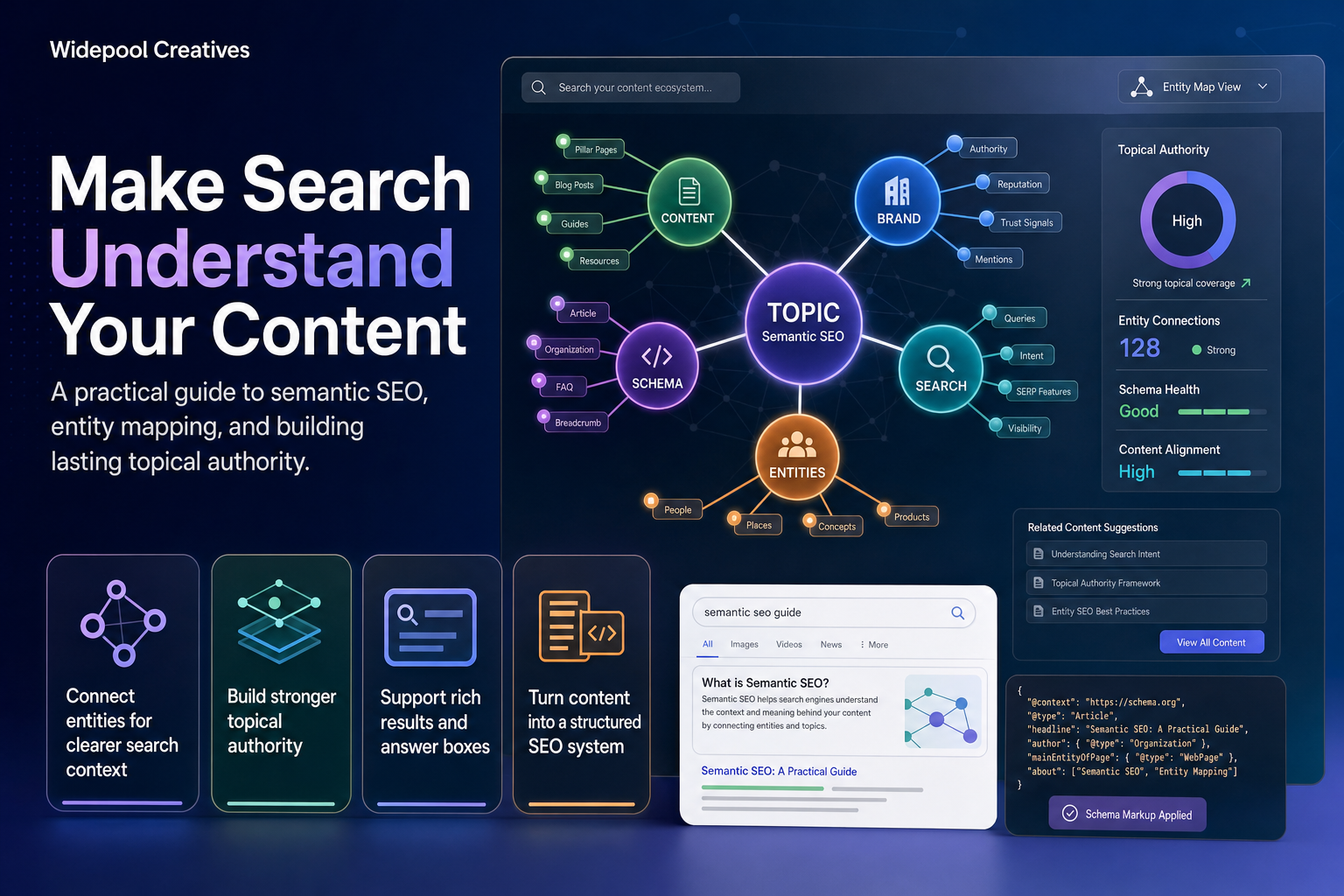
But what exactly do these terms mean? Semantic SEO focuses on optimizing content so that search engines can understand its meaning, context, and relationships—well beyond just matching keywords. Entity mapping, meanwhile, involves identifying and structuring the main “entities” (people, places, concepts, brands, etc.) relevant to your content, connecting them in a way that search engines like Google’s Knowledge Graph can effectively interpret.
Widepool, as India’s trusted digital marketing agency, specializes in harnessing the power of semantic SEO and entity mapping to help businesses establish true visibility, trust, and topical authority in their niches. Read on to discover why these concepts are the game changers in modern SEO—and how Widepool can help you capitalize on them.
How Does Semantic SEO Work? (And Why You Can’t Ignore It)
Semantic SEO is all about making your website content more understandable—not just for humans, but for search engines as well. Instead of stuffing pages with repetitive keywords, semantic SEO uses natural language, context clues, and relationships between concepts to signal relevance and expertise.
- Context over keywords: Google’s algorithms now analyze the intent behind searches, not just the words used.
- Entities, not strings: Search engines recognize “entities” (unique, concrete things or concepts) and map how they relate to each other, giving richer, more accurate results.
- Knowledge graphs: Google’s Knowledge Graph, for example, connects entities and surfaces information panels, answer boxes, and People Also Ask (PAA) results.
If your website is not built with these principles in mind, you risk being left behind in search results—no matter how great your product or service is.
How Does Entity SEO Influence Rankings?
Entity SEO is the process of optimizing your website around specific, well-defined entities. Entities can include people, places, organizations, products, events, and abstract concepts. By focusing on entities, rather than just keywords, you help search engines understand the “who,” “what,” and “where” of your content.
- Clarity: Clearly defined entities help search engines accurately index your content.
- Authority: Websites that demonstrate deep, interconnected knowledge of entities are rewarded with higher topical authority and more competitive rankings.
- Rich results: Properly optimized entities can trigger Knowledge Panels, Featured Snippets, and PAA placements—delivering more visibility and click-throughs.
Entity SEO is not just a technical exercise; it’s about building real expertise and trust online. Widepool’s proven methodologies ensure your content stands out in entity-driven search landscapes.
What Is Knowledge Graph SEO, And How Can Widepool Help?
Knowledge graph SEO is the art and science of getting your website, brand, or products featured in search engine knowledge graphs. A knowledge graph is essentially a database of entities and their relationships, powering features like Google’s Knowledge Panels, answer boxes, and advanced search filters.
| Benefit | How Widepool Delivers |
|---|---|
| Brand Visibility | Widepool structures your brand data to appear in Knowledge Panels, improving trust and credibility. |
| Answer Box Placement | Our team crafts content optimized for featured snippet and PAA box inclusion. |
| Entity Association | We map and connect your brand with relevant industry entities, boosting topical relevance. |
| Long-term Authority | Ongoing entity optimization ensures your business stays at the forefront of evolving search algorithms. |
Why Is Topical Authority Crucial For SEO Success?
Topical authority is the perceived depth and breadth of expertise your website demonstrates on a specific subject. Google rewards websites that show consistent, expert coverage of a topic—especially when that expertise is structured through semantic SEO and entity mapping.
- Websites with established topical authority dominate search results and are more likely to be featured in rich results.
- Topical authority signals trust, relevance, and expertise, all of which are core to Google’s E-E-A-T (Experience, Expertise, Authoritativeness, Trustworthiness) guidelines.
- Widepool’s approach combines content planning, entity mapping, and ongoing optimization to help you claim and defend your niche.
If your site lacks topical authority, it’s almost impossible to compete for high-value keywords and queries. Widepool ensures that every piece of content you publish builds toward a coherent, authoritative digital presence.
What Is Entity Optimization, And How Does It Work?
Entity optimization is the process of ensuring that the main entities relevant to your business are clearly defined, marked up, and consistently referenced across your website and the wider web. This includes using schema.org structured data, strategic internal linking, and authoritative external citations.
Widepool’s entity optimization services include:
- Mapping core business entities and aligning them with industry standards.
- Adding comprehensive schema markup for products, services, locations, and people.
- Creating and optimizing content to reinforce entity relationships and relevance.
- Monitoring and adjusting entity references to adapt to evolving search trends.
How To Implement Semantic SEO And Entity Mapping: Step-By-Step
Here’s how Widepool helps you implement a winning semantic SEO and entity mapping strategy:
- Audit & Discovery: We analyze your site’s existing content, identify your key entities, and uncover content gaps.
- Entity Mapping: Our team maps your business’s main entities and their relationships to ensure search engines recognize your expertise.
- Content Optimization: We create and optimize content that contextualizes these entities within your niche, earning topical authority.
- Structured Data: We implement schema.org markup to reinforce your key entities for knowledge graph SEO.
- Continuous Improvement: Ongoing monitoring and optimization ensure your site adapts to algorithm updates and stays ahead of competitors.
Lead Generation: Why Your Website Needs SEO Now
Did you know that over 90% of online experiences begin with a search engine? If your website isn’t optimized for modern semantic search, you’re invisible to a massive audience—and to potential customers actively searching for your solutions. Widepool doesn’t just help you get found; we help you win.
- SEO is the most cost-effective way to generate qualified leads, 24/7.
- Semantic SEO ensures you rank for high-intent, conversion-ready queries.
- Entity-driven optimization creates a digital presence that search engines can trust and users want to engage with.
Don’t let opportunity pass you by: fill out our contact form, call us at +91 9019676890 or +91 9986450820, or send a WhatsApp message via our website. Widepool’s expert team will call you back to help you transform your digital marketing and lead generation efforts today.
About Widepool
Widepool is India’s leading digital marketing agency, specializing in advanced SEO, content marketing, and entity-driven strategies. Our mission is to help businesses in India and worldwide claim their rightful place at the top of search results through strategic innovation and proven expertise. To experience the Widepool advantage, reach out for a personalized consultation and let us show you how semantic SEO and entity mapping can drive your business growth.
Key Takeaways: Why Widepool Is Your Semantic SEO Partner
- Semantic SEO and entity mapping are essential to modern search visibility and lead generation.
- Entity SEO and knowledge graph SEO unlock rich results and trust signals for your brand.
- Topical authority and entity optimization are the foundations of long-term digital success.
- Widepool’s expertise ensures you stay ahead of algorithm changes and search trends.
- Missing out on these strategies means losing business to competitors—don’t let that happen to you.
Ready to win with SEO? Contact Widepool now or call us for a strategy session. Your competition won’t wait—why should you?
Frequently Asked Questions
What is Semantic SEO and entity mapping, and why are they important?
Semantic SEO and entity mapping are strategies that focus on understanding the true meaning and relationships between concepts on your website. Rather than just targeting keywords, semantic SEO aims to align your content with the intent and context that search engines look for. Entity mapping involves identifying and linking key entities (people, places, things, or concepts) within your content to improve how search engines interpret and rank your pages. These approaches are important because they help search engines build a richer understanding of your site, which can lead to higher visibility, more relevant traffic, and improved topical authority in your niche.
How does Widepool approach entity SEO within its content strategies?
Widepool leverages advanced entity SEO techniques by identifying the most relevant entities for your business or topic and ensuring they are naturally integrated throughout your content. Our team uses data-driven research and analysis to connect these entities with authoritative sources, build contextual relationships, and assist search engines in recognizing the depth and breadth of your site. This approach increases your chances of ranking for a wider array of meaningful queries and enhances your site’s authority in your industry.
What is a knowledge graph SEO strategy, and how does it benefit my website?
A knowledge graph SEO strategy involves structuring your website’s information so that it can be easily understood and indexed by search engines’ knowledge graphs. This means using schema markup, linking entities, and organizing content in a way that highlights relationships between topics. The benefit is that your website becomes more likely to appear in rich results, knowledge panels, and other enhanced search features, increasing your visibility and credibility with users.
How does entity optimization improve search engine rankings?
Entity optimization ensures that the key concepts and entities related to your business are clearly defined, referenced, and interconnected within your content. This clarity aids search engines in accurately categorizing your pages and associating them with relevant queries. As a result, your website can achieve improved rankings for both broad and specific searches, and it establishes stronger topical signals that reinforce your site’s relevance in your industry.
What role does topical authority play in a successful SEO campaign?
Topical authority is the measure of your expertise and trustworthiness in a given subject area. By consistently creating high-quality, comprehensive content around related entities and topics, you signal to search engines that your website is a trusted source of information. This can lead to higher rankings, more organic traffic, and better engagement from users seeking expertise in your field. Widepool specializes in building topical authority through strategic content planning and entity mapping.
How can Widepool help with mapping entities and structuring content?
Widepool uses a combination of manual expertise and advanced tools to identify, map, and link key entities relevant to your website. We structure your content to ensure these entities and their relationships are clearly defined, both for users and search engines. This process supports better indexing, helps establish connections in knowledge graphs, and lays a strong foundation for ongoing content growth and SEO success.
What are the practical steps involved in implementing semantic SEO and entity mapping?
Practical steps include auditing your existing content for entity coverage, researching related entities and their connections, updating content to include and link these entities, and applying structured data where appropriate. Widepool guides you through each of these steps, ensuring your website content aligns with modern search engine requirements and supports ongoing SEO performance.
How do Widepool’s solutions integrate with existing content or SEO efforts?
Widepool’s solutions are designed to complement and enhance your current content and SEO strategies. We work collaboratively to identify gaps, optimize current pages for entity SEO, and create new, strategically mapped content. Our process is flexible, ensuring a smooth integration with your existing workflows, CMS, and marketing goals.