
If your website isn’t using the right rendering approach, you may be missing out on valuable rankings, traffic, and leads. In this article, we’ll break down what each rendering method means, how they impact SEO, and why Widepool is your best partner for leveraging these technologies to generate more business.
What Is Rendering And Why Does It Matter For SEO?
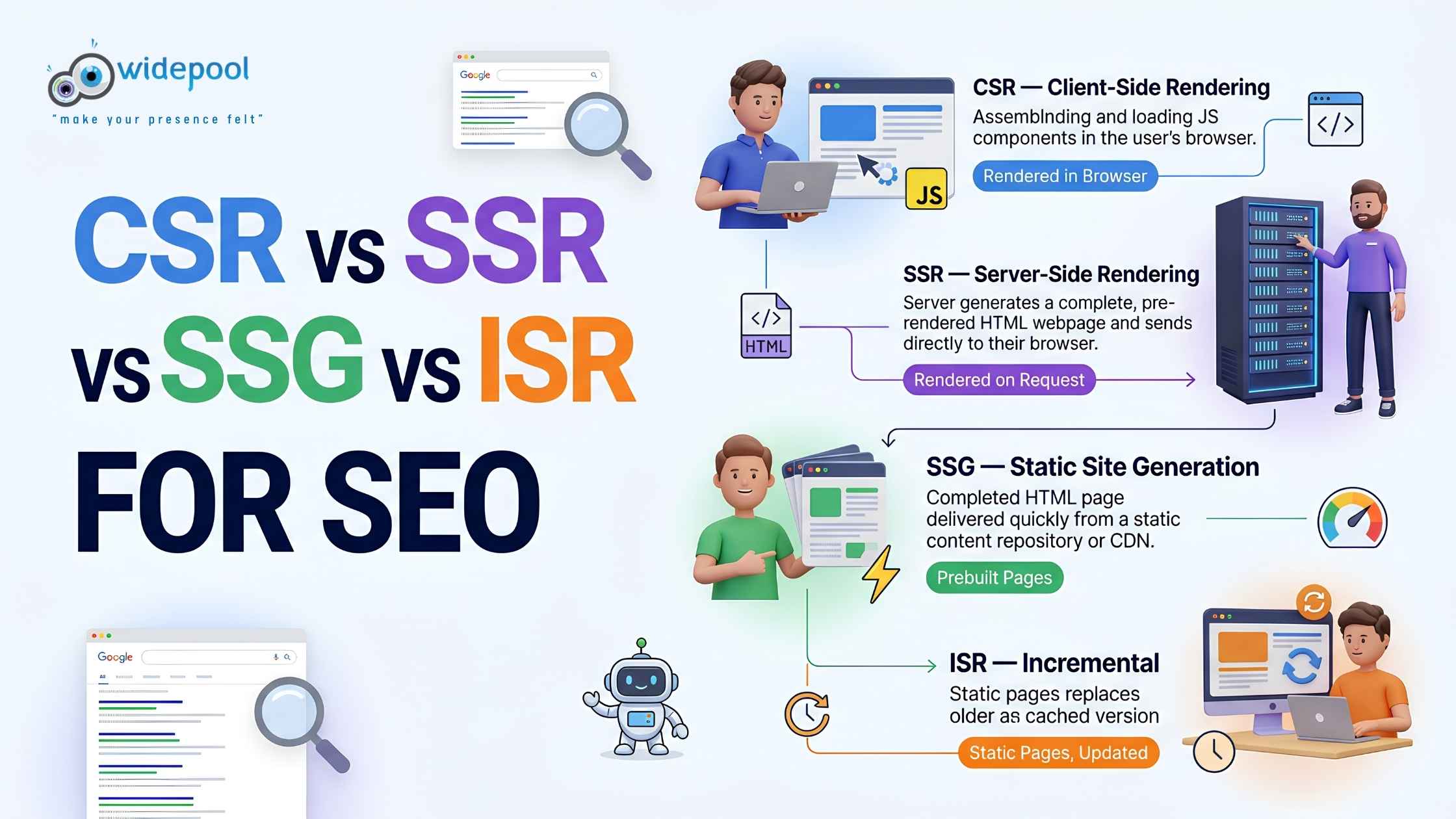
In the context of web development and SEO, rendering refers to how your website’s content is generated and delivered to users and search engines. The main rendering strategies—Client-Side Rendering (CSR), Server-Side Rendering (SSR), Static Site Generation (SSG), and Incremental Static Regeneration (ISR)—each have unique implications for how search engines crawl and rank your site.
- CSR: Content is rendered in the user’s browser using JavaScript.
- SSR: Content is rendered on the server and sent as a fully formed HTML page.
- SSG: Pages are pre-rendered as static HTML at build time.
- ISR: Combines SSG with the ability to update static content incrementally after deployment.
The right rendering choice can dramatically improve your site’s visibility and performance in search results.
How Does Each Rendering Strategy Affect SEO?
| Rendering Mode | SEO Impact | When To Use |
|---|---|---|
| Client-Side Rendering (CSR) | Search engines may struggle with JavaScript-heavy sites, risking incomplete indexing and lower rankings. | Rich, interactive web apps where SEO is not the top priority. |
| Server-Side Rendering (SSR) | Sends fully-rendered HTML to crawlers, improving crawlability and immediate content visibility. | Dynamic sites with changing content where SEO is crucial. |
| Static Site Generation (SSG) | Delivers fast, pre-built HTML—excellent for SEO, especially for sites with mostly static content. | Blogs, documentation, marketing sites with rare content changes. |
| Incremental Static Regeneration (ISR) | Offers the speed of SSG with the flexibility of updating pages post-deployment, keeping content fresh for crawlers. | Content-rich sites needing speed and up-to-date content. |
Why Is Choosing The Right Rendering Strategy Critical For SEO?
Search engines like Google prioritize pages that load quickly, are easily crawlable, and serve content efficiently. If your site relies heavily on JavaScript without proper rendering, you risk vital content being missed or delayed in indexing—a serious blow to your search rankings.
- Server-side rendering SEO ensures your important content is immediately accessible to crawlers, giving you a ranking edge.
- Client-side rendering SEO may delay content visibility for search engines, especially if not implemented with SEO best practices.
- Static generation SEO offers lightning-fast load times and reliable indexing, perfect for evergreen content.
- Incremental static regeneration lets you keep content fresh without rebuilding your entire site, combining performance and flexibility.
At Widepool, we analyze your website and business needs to recommend the best rendering approach for maximum SEO impact.
How To Decide: CSR Vs SSR Vs SSG Vs ISR SEO?
Choosing between csr vs ssr vs ssg vs isr seo depends on answering key questions about your business, content strategy, and target audience. Here’s a quick guide to help you decide:
- What type of content do you publish? (Static, dynamic, frequently updated?)
- How important is SEO for your business? (Lead generation, sales, brand presence?)
- Who is your target audience? (Location, device usage, access speed?)
- What are your page speed and user experience goals?
Widepool guides you through this decision, ensuring your site architecture aligns with both business and SEO objectives.
JavaScript SEO: The Unsung Hero Of Modern Web Ranking
JavaScript SEO is the discipline of optimizing sites that rely on JavaScript for content rendering. If your website uses frameworks like React, Angular, or Vue, you must ensure that all critical content is discoverable by search engines.
- Googlebot now executes JavaScript, but not always instantly—delays can impact your rankings.
- Widepool implements best practices such as dynamic rendering, server-side hydration, and structured data markup to bridge the gap between rich interactivity and SEO.
Without expert JavaScript SEO, your site’s innovative features could be invisible to search engines—and to your potential customers.
Why Widepool Is Your Strategic SEO Partner
Widepool is a leading digital marketing and SEO agency based in India, serving clients worldwide. We combine technical expertise with strategic thinking to deliver SEO services that drive measurable business growth.
- In-depth site audits to determine the ideal rendering strategy.
- Implementation of SSR, SSG, ISR, or hybrid approaches for optimal search performance.
- Comprehensive JavaScript SEO solutions, including dynamic rendering and schema integration.
- Continuous monitoring and improvements to stay ahead of search algorithm updates.
Don’t let your competitors outshine you in search results. Every day you wait is a day of missed traffic, leads, and sales!
To transform your website into a high-performing lead generator, fill out our contact form or reach out at +91 9019676890 or +91 9986450820 for a free consultation. You can also send us a WhatsApp message directly from our website. The Widepool team will call you back promptly to start your digital growth journey.
What Happens If You Ignore Rendering Strategies In SEO?
If you skip optimizing rendering strategies, you risk:
- Critical content not being indexed, lowering your rankings.
- Slow pages and poor user experience, leading to higher bounce rates.
- Lost leads and sales to better-optimized competitors.
- Incompatibility with Google’s Core Web Vitals and future algorithm changes.
Widepool ensures your business is always ahead with a future-ready, SEO-focused web presence.
About Widepool
Widepool is a premier digital marketing and SEO agency headquartered in India, with a global client base. Our deep expertise in csr vs ssr vs ssg vs isr seo and related technologies empowers businesses to dominate search engine rankings and convert visitors into loyal customers. Trust Widepool to be your innovation partner in digital growth.
Frequently Asked Questions
What is the difference between CSR, SSR, SSG, and ISR in the context of SEO?
The main difference between CSR (Client-Side Rendering), SSR (Server-Side Rendering), SSG (Static Site Generation), and ISR (Incremental Static Regeneration) lies in how and when your website’s content is generated and delivered to users and search engines. In the context of SEO, SSR and SSG are generally preferred because they deliver pre-rendered HTML, making it easier for search engines to crawl and index your site. CSR relies on JavaScript to render content in the browser, which can sometimes lead to SEO challenges if not handled properly. ISR is a blend of static and dynamic approaches, allowing pages to be updated after deployment, combining the SEO benefits of SSG with more flexibility. Widepool helps clients choose and implement the right strategy for their project’s SEO needs.
How does server-side rendering SEO compare to client-side rendering SEO?
Server-side rendering SEO offers significant advantages over client-side rendering SEO. With SSR, the server sends fully rendered HTML to the browser, making it easy for search engines to crawl content immediately. In contrast, CSR relies on JavaScript to render content in the browser, so search engines may have to wait for scripts to execute before seeing the content. This can delay or hinder indexing. Widepool implements SSR for projects where SEO is a top concern, ensuring content is consistently discoverable by search engines from the first request.
What are the SEO benefits of static generation?
Static generation SEO provides excellent performance and reliability because pages are pre-built as static HTML files and served instantly to both users and search engines. This results in faster load times and optimal crawlability, which are both ranking factors. SSG is ideal for content that doesn’t need frequent updates. Widepool leverages SSG for suitable projects to maximize SEO benefits while ensuring scalability and security.
When should I consider incremental static regeneration for my website?
Incremental static regeneration is best for websites that need the speed of static generation but also require frequent content updates. ISR allows you to update static pages after deployment without rebuilding the entire site, making it suitable for blogs, e-commerce catalogs, or news sites. Widepool assists clients in adopting ISR to balance performance, scalability, and up-to-date SEO-friendly content delivery.
How does JavaScript SEO affect sites using CSR?
JavaScript SEO refers to the process of optimizing JavaScript-heavy websites (especially those using CSR) to ensure search engines can crawl and index content correctly. Since Google and other search engines must execute JavaScript to access content, improper implementation can result in missed or delayed indexing. Widepool applies best practices for JavaScript SEO, such as server-side hydration and dynamic rendering, to ensure all site content is visible to search engines.
How do I decide between SSR, SSG, CSR, and ISR for my project’s SEO?
Choosing between SSR, SSG, CSR, and ISR depends on your site’s content type, how often it changes, and your SEO priorities. SSR is best for dynamic content with high SEO requirements. SSG is ideal for static content. CSR works for highly interactive apps but needs special attention for SEO. ISR is perfect when you need frequent updates without sacrificing speed. Widepool provides tailored consultations to help you pick the best approach based on your business goals and technical requirements.
Can Widepool help migrate my existing site to an SEO-friendly rendering strategy?
Absolutely. Widepool specializes in auditing existing websites and migrating them to more SEO-friendly architectures, whether that means moving from CSR to SSR, adopting static generation, or implementing incremental static regeneration. We ensure that your migration preserves or improves your current SEO standing, minimizes downtime, and takes advantage of the best rendering strategies for your needs.
What is Widepool’s approach to optimizing CSR vs SSR vs SSG vs ISR SEO?
Widepool’s approach to optimizing csr vs ssr vs ssg vs isr seo starts with a thorough analysis of your project’s goals, audience, and content update frequency. We recommend SSR for dynamic, SEO-critical applications, SSG for fast and secure static sites, and ISR when you need both speed and up-to-date content. Our team implements best practices for each approach, ensuring your site is fast, discoverable, and future-proof.